Iran, the Jewish People and IsraelCIE+
May 18, 2025 Contradiction has been a theme in Iran’s relationship with the Jewish people, for nowhere else in the Muslim world have Jews both suffered so grievously and flourished so thoroughly. Nor is the…
Visiting Qatar after Saudi Arabia and before the United Arab Emirates in a Middle East trip that excluded Israel, President Donald Trump praises and pledges to defend Qatar and indicates a deal on Iran’s nuclear program is close.
January 9, 2025 By Dr. Kenneth Stein, Emeritus Professor, Emory University As the 39th president of the United States, James Earl Carter held office from 1977 to 1981. Carter was the longest-surviving former United States president…
December 11, 2024 Professor Meir Litvak, Tel Aviv University, for the Center for Israel Education In this extraordinary review, Professor Meir Litvak unfolds the ideological origins and development of the Iranian regime’s stark hatred of…
Compiled by Aidan New Before Iran launched nearly 200 ballistic missiles at Israel on Oct. 1, 2024, it targeted Israel on April 13 and 14, 2024, with a series of missiles and drones, escalating regional…
Compiled by Aidan New Iran’s development of a nuclear weapons program began in the late 1990s, accelerated in the early 2000s, and has remained a focal point for regional tension and international sanctions. It is…
Compiled by Aidan New Iran, a Shia- and Persian-majority theocracy, frequently clashes with its Sunni Arab neighbors, including Bahrain, Egypt, Saudi Arabia, and the United Arab Emirates. These tensions are rooted in religious and ethnic…
Compiled by Aidan New Iran has financed, armed, trained, and, in some cases, directed terrorist and militant groups such as Hamas, Hezbollah and the Houthis around the Middle East to incorporate them into its ultimate…
Compiled by Aidan New Iran lies behind much of what Israel has battled since Hamas launched its brutal terrorist attack Oct. 7, 2023. By theology and ideology, Iran is committed to Israel’s destruction. By policy…
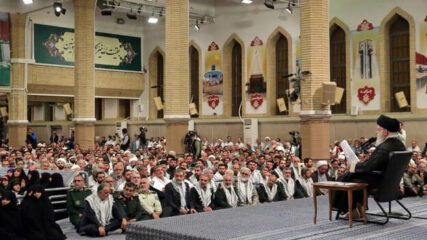
Iranian Supreme Leader Ayatollah Ali Khamenei delivers a synopsis of Iran’s hatred of Israel and the United States, provides deep insight into his unwavering commitment to destroying Israel, and mourns for slain Hezbollah leader Hassan Nasrallah.
Iran exerts an immense amount of influence over its most successful proxy creation, Hezbollah.
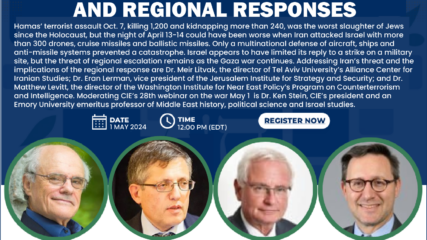
Hamas’ terrorist assault Oct. 7, killing 1,200 and kidnapping more than 240, was the worst slaughter of Jews since the Holocaust, but the night of April 13-14 could have been worse when Iran attacked Israel…
Former US President Jimmy Carter embraced Hamas as a legitimate voice of the Palestinian people. His motivations possibly stretched from intentional to misguided to malevolent. Hamas leaders who were engaged in inter-Palestinian struggles remained pleased with the recognition he gave them. American officials and Israelis were keenly perturbed by the courtship he gave them.
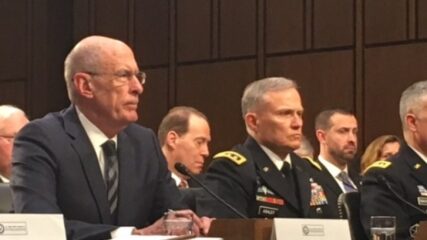
On Jan. 29, 2019, U.S. Director of National Intelligence Dan Coats told the Senate Select Committee on Intelligence: “We do not believe Iran is currently undertaking the key activities we judge necessary to produce a nuclear device.” However, experience helps us realize that the American intelligence community has a very problematic track record in revealing, on time, nuclear weaponization efforts of many countries (e.g., North Korea, India, Pakistan, Syria, and Iraq) including Iran itself, so one has to be very humble about this kind of assessment.
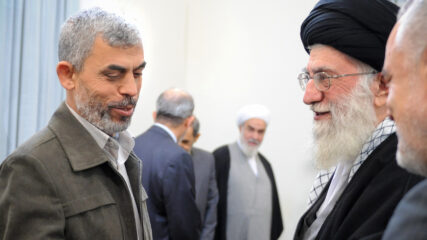
Yahya Sinwar, the Hamas leader in Gaza and mastermind of the October 7 attack, repeatedly expressed his desire to destroy Israel and his gratitude for Iran’s support.
There is much discussion around the world about how to prevent Iran from obtaining nuclear weapons. But few, if any, international bodies deal with the question of how to prepare for the day Iran achieves such capabilities, if that day has not already arrived.
After a year in which Iran opted for “strategic patience,” in the hope that European nations would compensate for the United States sanctions, it now seeks to present a price tag for the US measures against it, and has thus embarked on a response comprising action in three realms: nuclear, military, and oil exports from the Gulf. In the current circumstances, Iran and the United States are demanding conditions that would make a resumption of negotiations difficult, although both sides apparently understand that dialogue may ultimately be the less dangerous option for them.
In a bold move, the Trump administration has designated the Iranian Revolutionary Guard Corps (IRGC) as a Foreign Terrorist Organization (FTO). This is historical justice, since the IRGC has sponsored various terrorist militias and organizations, Shiite and Sunni alike, which have committed many attacks against Western, Israeli and Sunni targets.
The US can and should develop a coherent region-wide strategy, involving US allies including Israel, to impede Iran’s ability to continue developing in ways detrimental to the region’s security. However, Iran is proficient in the practice of using proxies and paramilitary methods, as well as in the combination of paramilitary and political struggle. Its response to a US-led strategy to contain and roll back their influence is likely to focus on these areas.
President Trump in 2018 enumerates the behaviors Iran must change to enter a deal replacing the JPOA and thus creates a basis for judging his own negotiations with Tehran.
With reams of evidence secured by Israeli intelligence, the PM calls out Iran for lying about their nuclear activities both before and since signing the 2015 JCPOA nuclear agreement with six countries.
Netanyahu reproaches the international community for supporting the Iran deal, the UN for its deafening silence against threats to Israel, and, against Palestinian leader Mahmoud Abbas for promising to cancel all agreements with Israel.
In the interest of securing any deal rather than the right deal – politics over principle – the president and the diplomats he sent to negotiate seem to have forgotten or perhaps never learned why Iran must not get a nuclear weapon.
On July 14, 2015, Iran and the five permanent members of the UN Security Council plus Germany (P5+1) concluded a Joint Comprehensive Plan of Action (JCPOA) concerning the future of Iran’s nuclear program.