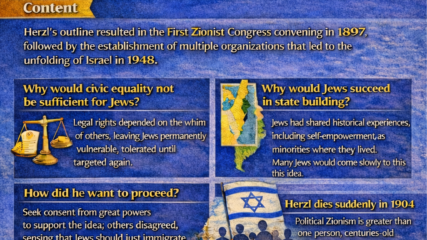
9 Key Questions About Theodor Herzl’s “The Jewish State,” February 14, 1896CIE+
Nine questions guide key understandings about Theodor Herzl’s “The Jewish State.”
Israel is competing in bobsled, alpine and cross-country skiing, skeleton, and figure skating at the 2026 Winter Olympics in Milan and Cortina, Italy.
November 29, 1947 Official Records of the General Assembly, Second Session Supplement No. 11,Volumes l-lV. Deteriorating Relationship Between Britain and Palestine The British intention (Peel Report in 1937) to partition Palestine into Arab and…
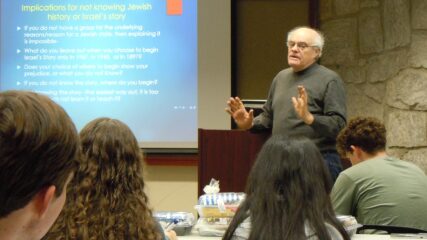
Teen participants have shown uniform enthusiasm for their interactive engagements with peers at Center for Israel Education programs. See their responses in their own words.
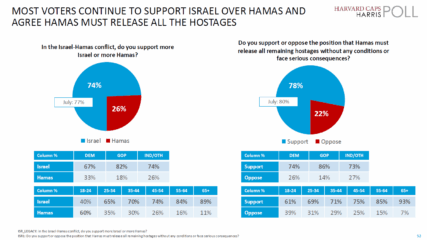
August 2025 polling data about American attitudes toward Israel and Hamas and about American political party partisanship toward Israel over the past decade.
August 10, 2025 Updated August 11, 2025, with follow-up resources. CIE and partners including including Hillels of Georgia, American Jewish Committee, the Jewish Federation of Greater Atlanta’s JTeen initiative, the Anti-Defamation League, the Jewish Community…
Divided at home and condemned abroad, public opinion of Israel sinks in response to war and domestic politics.
The Brooklyn Nets drafted two Israelis, Ben Saraf and Danny Wolf, back to back in the first round of the 2025 NBA Draft on June 25.
From Ancient Times to the 19th Century The bond between the Jewish people and the Land of Israel is one of the most enduring in human history. Since the Roman destruction of the Second Temple…
May 18, 2025 Contradiction has been a theme in Iran’s relationship with the Jewish people, for nowhere else in the Muslim world have Jews both suffered so grievously and flourished so thoroughly. Nor is the…
By Scott Abramson and Ken Stein, April 4, 2025 The Exile and the Homeland It may be said that the Jewish people’s entire cosmology (the origin and nature of the universe) from their birth as…
By Scott Abramson and Ken Stein In his famous 2004 essay “Between Right and Right,” Israel’s most celebrated novelist, Amos Oz, reflects on Israeli society, summing up his fellow citizens with this appraisal: “What we,…
By Aidan New and Michael Jacobs (updated April 9) President Donald Trump’s second administration had an impact in the Middle East even before his inauguration Jan. 20, 2025: Special Middle East envoy Steven Witkoff was…
April 8, 2024 By Scott Abramson If, in the eyes of a generation, social justice is the highest good and racism the greatest evil, shouldn’t that generation fiercely oppose history’s oldest and deadliest bigotry, antisemitism? …
America’s need for a robust higher education system, where students learn to think deeply, engage respectfully, and disagree constructively, is greater than ever.
Since the June 1967 war, Anti-Israeli sentiment on US campuses has grown to extraordinary proportions merging with previously evolved anti-Zionism into sporadic mention to regular embrace.
Sung or recited on Passover, the original Dayenu is reflective appreciation of 14 significant events specifically wrapped around the exodus from Egypt. The Dayenu presented here chronicles Jewish history from Exodus to the present day. This history can be read individually or responsively. Different moments and personalities in Jewish history could have been included. Hebrew and Spanish versions of Dayenu are available.
Neither Israel’s political culture nor Israel’s democracy based on Jewish self determination simply materialized on May 15, 1948. A connection exists from Jewish self-rule in the Diaspora to Zionist political autonomy during the Yishuv and to contemporary Israeli political culture. Likewise, the origins of Israeli democracy are found in the hundreds of years of Jewish Diasporas transitioning into the Zionist movement to the state; from aliyot before the Palestine Mandate to 1948 and since. Components of Israeli political culture…
“We are very grateful for the learning and the PD that the program provides our faculty and look forward to continuing this in the next school year 2022-23.” Sinai Akiba, Los Angeles, CA “For years…
Dr. Tal Grinfas-David, March 1, 2022 When it comes to boosting Israel education, some schools go through transactional changes, and some go through transformative changes. What’s the difference? Transactional schools add units and information, making…
Steven Bayme In early November 2021, The New York Times Magazine posted an essay under the provocative title “Inside the Unraveling of American Zionism.”1 The essay focused on a letter signed by 93 rabbinical and…
Isaac “Bougie” Herzog’s election as Israel’s 11th president on June 2 was such “big” news that it was all but impossible to find on the home page of The Times of Israel a day later. That’s because reporting on a largely ceremonial position was overwhelmed by the end of a two-year wait for the monumental announcement of an eight-party government coalition, including Islamist Arabs and religious Zionist Jews, to unseat the longest-serving prime minister in Israel’s history.
Do you think any of the Maccabees would have guessed that the one jar of oil would have kept the menorah burning in Mod’in for eight days rather than one? If one had predicted yes or no, there probably would not have been either good or bad consequences in the years after 165 BCE.
Using original sources and employing perspective are keys to substantive Israel education. Failure to use either, handicaps and prejudices learning about Israel. When documents and texts or a broad overview of the literature in a field are not employed, there is a strong possibility that the educator either has a personal political agenda or, is covering up for their own lack of knowledge of what they are teaching. This premise is true for teaching any country’s history and through the lens of any discipline. I reside in the discipline of history.