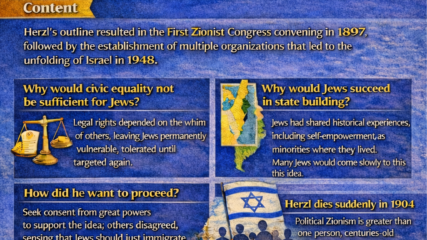
9 Key Questions About Theodor Herzl’s “The Jewish State,” February 14, 1896CIE+
Nine questions guide key understandings about Theodor Herzl’s “The Jewish State.”
The First Commonwealth: Kingdom of Israel/the United Monarchy (circa 1030-930 B.C.E.) under Kings Saul, David and Solomon. The monarchy split into two kingdoms in 930 B.C.E. The northern Kingdom of Israel endured until 722 B.C.E., when…
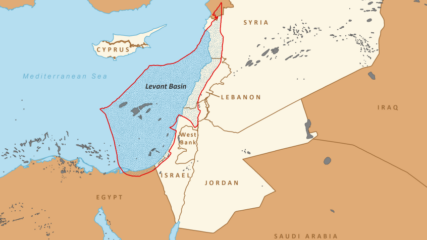
When the British and the French decided on the borders of some modern Middle Eastern states in the Levant in the 1915-1922 period, no Palestinian, Syrian, Iraqi, Jewish, Lebanese or Jordanian state existed. Before the…
Stein, Kenneth, “Legal Protection and Circumvention of Rights for Cultivators in Mandatory Palestine,” in Joel S. Migdal, (Ed.) Palestinian Society and Politics, Princeton, (1980): 233-260. In the immediate wake of communal violence that plagued Palestine…
By Ken Stein and Scott Abramson, March 23, 2025 Zionist/Jewish Economic Development in Palestine Before 1948 Jewish physical growth in Mandatory Palestine in the period known as the New Yishuv was sufficient through land acquired…
By Scott Abramson and Ken Stein In his famous 2004 essay “Between Right and Right,” Israel’s most celebrated novelist, Amos Oz, reflects on Israeli society, summing up his fellow citizens with this appraisal: “What we,…
Kenneth Stein, “Palestine’s Rural Economy, 1917-1939,” Studies in Zionism, Vol. 8, No. 1 (1987), pp. 25-49. During the early decades of the 20th century in Palestine, the majority Arab population sustained itself primarily through agricultural and pastoral…
By Scott Abramson A Disadvantaged Land in a Pivotal Location The State of Israel lies at the eastern edge of the Mediterranean Sea, at the intersection of three continents: Asia, Africa and Europe. Together with…
April 14, 2025 The period of the New Yishuv lasted from the last 40 years of Ottoman rule in Palestine through the British Mandate until the establishment of Israel in 1948. It saw the growth…
From the biblical covenants, Jews bound themselves to the belief in one G-d, an unbreakable tie to the Land of Israel. From its inception, Jewish identity was wrapped around the mutual commitments between G-d and the people. Judaism became the foundation for Christianity and Islam.
From 1898 to 1948, Zionism evolved from an idea to a concrete reality: the actual establishment of the Jewish state, Israel. Slowly, a few immigrating Jews created facts by linking people to the land. For half a century, fortuity and fortitude made the Zionist undertaking a reality. They exhibited pragmatism and gradually constructed a nucleus for a state. Through perseverance Zionists empowered themselves.
Kenneth W. Stein, “Zionist Land Acquisition: a core element in establishing Israel,” in Michael J. Cohen, (ed.) The British Mandate in Palestine: A Centenary Volume, 1920-2020, Routledge, 2020, pp. 189-204.
The announcement by US Secretary of State Mike Pompeo that “the establishment of Israeli civilian settlements in the West Bank is not, per se, inconsistent with international law” is in line with Israel’s official position, and its inherent message – that preoccupation with the question of the legality of the settlements narrows Palestinian flexibility and discourages the achievement of a negotiated resolution to the conflict – is correct. However, the announcement’s practical value is minor, and there are even potential risks and costs for Israel.
On March 25th 2019, President Trump signed an order for the United States’ official recognition of Israeli sovereignty over the Golan Heights. This article surveys Israeli public opinion regarding this issue, and its reactions to this announcement. Surveys have shown a consistently high level of support among Jewish Israelis for keeping the Golan Heights, and while there is some disagreement – Jews across the political spectrum support President Trump’s decision.
Placing Jewish destiny into Jewish hands was why Zionism emerged at the end of the 19th century. Acquiring political power to promote Jewish security is how a Jewish state was created.
“The Quest for Arab-Israeli Peace: Israel’s Disengagement from the Gaza Strip: Precedents, Motivations and Outcomes” Zionism Fulfilled.- Israel’s preemptive physical disengagement from the Gaza Strip in August 2005 was the result of a national consensus;…
“A Zionist State in 1939,” Dr. Kenneth W. Stein, CHAI (Atlanta), Winter 2002 “Had not the Nazi crimes been committed against Jews during World War II, the Jewish State would have never come true.” So…
Kenneth W. Stein, “One Hundred Years of Social Change: The Creation of the Palestinian Refugee Problem,” in Laurence Silberstein (ed.), New Perspectives on Israeli History: The Early Years of the State, New York University Press,…
Kenneth Stein, “Rural Change and Peasant Destitution: Contributing Causes to the Arab Revolt in Palestine, 1936-1939,” John Waterbury and Farhad Kazemi (eds.), Peasants and Politics in the Modern Middle East, Florida International University Press (1989), pp. 143-170….
The 1937 plan to partition Palestine was never implemented. It did, however, remain a workable political option for resolving the conflict between Arabs and Zionists. Britain needed to placate Arab state opposition to Zionism, so it refrained from actively revisiting the partition plan.
Primary sources, reputable scholarship and archival materials collectively show major communal (Arab-Jewish) socio-economic separation, factors that foreshadowed geo-spatial partition.