<span class="cie-plus-title">Yom HaZikaron – Israel’s Memorial Day: Suggested Links for Learning and Commemoration</span><span class="cie-plus-badge">CIE+</span>

Yom HaZikaron – Israel’s Memorial Day: Suggested Links for Learning and CommemorationCIE+

Yom HaZikaron (Day of Remembrance) is Israel’s Memorial Day. In the early years of statehood, memorials for soldiers who had fallen in the 1948 War of Independence were held on Yom Ha’Atzmaut, Israel’s Independence Day. After Prime Minister David Ben-Gurion appointed a special committee, the memorials were moved to the 4th Iyar, the day before Yom Ha’Atzmaut. The day was anchored into Israeli law in 1963 with the passage of the Heroes’ Remembrance Day (War of Independence and Israel Defense Army) Law. This law was amended in 1980 to Memorial Day for the Fallen of Israel’s Wars Law.


Curriculum/Syllabi|April 21, 2020
<span class="cie-plus-title">Origins of Yom Hashoah: Holocaust Memorial Day</span><span class="cie-plus-badge">CIE+</span>

Origins of Yom Hashoah: Holocaust Memorial DayCIE+

Using original sources, learners will explore the origins of Yom Hashoah, Holocaust Memorial Day, in Israel. The unit includes historical discussion on the importance of commeorating the tragedy of the Holocaust and different proposals that were put forward in the Land of Israel both before and after the creation of the state doing so. A writing prompt is included for use in school settings.

Issues and Analyses|April 14, 2020
<span class="cie-plus-title">The Widening Military–Political Gap in Israel</span><span class="cie-plus-badge">CIE+</span>

The Widening Military–Political Gap in IsraelCIE+

Over the last decade, the gap between the military and political elites in Israel has increased and eventually peaked in 2019, when a group of senior officers who had just retired from the Israel Defense Forces (IDF) formed a new party – led by three former chiefs of staff – and called for the replacement of Prime Minister Benjamin Netanyahu’s government. This gap has developed because Israel’s previous govern­ments have represented a new kind of polarizing, right-wing politics beyond what is considered a shared national common sense.

Issues and Analyses|February 7, 2020
<span class="cie-plus-title">Is a New Wind Blowing through the State Comptroller’s Office?</span><span class="cie-plus-badge">CIE+</span>

Is a New Wind Blowing through the State Comptroller’s Office?CIE+

The State Comptroller’s Office is the only institution outside of the defense establishment that conducts comprehensive and independent audits of security matters; hence its importance to national security. In the view of newly-appointed State Comptroller and Ombudsman Matanyahu Englman, an audit is meant to be a constructive process that addresses issues of national value; the audit process is a tool that supports the government and prime minister; audits that are liable to affect real-time decision making should be avoided; and the Comptroller should also report on the success of those audited. By contrast, his predecessor, retired judge Yosef Shapira, stressed that the State Comptroller is not the government’s in-house auditor and that audits do not depend on the good will of any external party.

Issues and Analyses|August 19, 2019
<span class="cie-plus-title">The Nation-State Law, One Year Later: What has Changed?</span><span class="cie-plus-badge">CIE+</span>

The Nation-State Law, One Year Later: What has Changed?CIE+

From a practical standpoint, the Nation State law’s ramifications are not yet clear. Neither its opponents nor its supporters ever claimed that it would immediately create a totally new situation in Israel. By its nature, a constitutional amendment of this sort, at the vaguest and most general level possible of the definition of the state, years will go by before all its provisions have been interpreted and before they trickle down to substantive changes on the ground.

Issues and Analyses|August 2, 2019
<span class="cie-plus-title">Explainer: Declaration of Independence (4:48)</span><span class="cie-plus-badge">CIE+</span>

Explainer: Declaration of Independence (4:48)CIE+

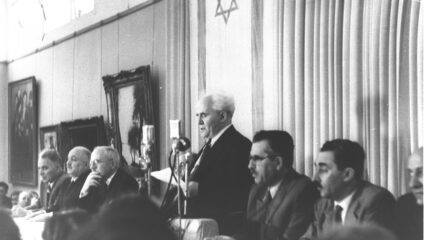
Israel’s Declaration of Independence which was issued by David Ben-Gurion in Tel-Aviv on May 14, 1948 was drafted by a small committee. This video highlights the similarities and differences between the Israeli and American declarations of independence and outlines the Israeli Declaration’s contents including the state’s intentions towards its citizens, the historical connection of the Jewish people to the Land of Israel, and the right of the Jewish people to determination.

Explainer Videos|May 9, 2019
<span class="cie-plus-title">The Ramifications of the Nation-State Law: Is Israeli Democracy at Risk?</span><span class="cie-plus-badge">CIE+</span>

The Ramifications of the Nation-State Law: Is Israeli Democracy at Risk?CIE+

The discussion surrounding the Nation-State Law has sparked a heated debate in Israeli society. One side claims that the law is a proper and necessary legislative anchor for the national character of the State of Israel as the state of the Jewish people, against those who seek to deny the Jewish people’s right to a national home in its homeland. The other side argues that this is discriminatory legislation, which undermines the democratic nature of the State of Israel.

Issues and Analyses|August 1, 2018
Knesset Establishes Bank of Israel

Knesset Establishes Bank of Israel

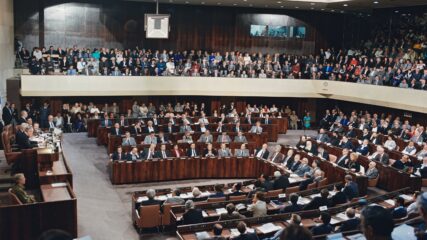
The Knesset passes the Bank of Israel Law by a vote of fifty-five to zero with fourteen abstentions. The new law, which goes into effect on December 1, 1954, establishes the Bank of Israel as the central financial authority for the country.

Today in Israeli History|August 24, 1954