Cards List
FILTERED BY:
Moshe Naor, “Israel’s 1948 War of Independence as a Total War,” 2008

Moshe Naor, “Israel’s 1948 War of Independence as a Total War,” 2008 CIE+ members only

Examination of the mobilization of society for the Israeli War of Independence effort enables one to present a more extended process that began in October 1947 — some two months prior to the outbreak of the war — and ended, from the standpoint of mobilization of personnel, at the beginning of 1949, when demobilization of the first draftees from the wartime army took place, and from an economic standpoint in April 1949, when an Austerity system was declared in the State of Israel.

Issues and Analyses|December 28, 2022
Three Scenarios for the Development of the Sisi Regime in Egypt

Three Scenarios for the Development of the Sisi Regime in Egypt CIE+ members only

A referendum on a constitutional amendment is to be held in Egypt at the beginning of May, which would enable President Abdel-Fatah al-Sisi to continue governing after the end of his current term. In the face of massive repression, approval seems certain. This would largely complete the power consolidation of the Sisi-regime, which emerged from the military coup of July 2013. But how will this regime develop in the future? Possible scenarios are a successful development dictatorship, decades of political and economic stagnation, as under Hosni Mubarak, or imminent failure.

Issues and Analyses|March 29, 2019
The Egyptian-Israeli Peace Treaty at 40: Lessons Learned and Impacts Sustained

The Egyptian-Israeli Peace Treaty at 40: Lessons Learned and Impacts Sustained CIE+ members only

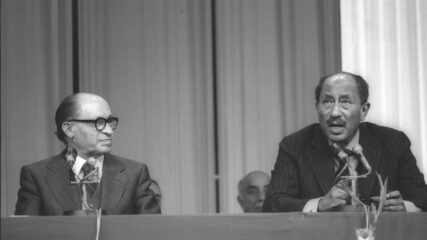
On a stormy evening on Sept. 17, 1978, with President Jimmy Carter as their witness, Egyptian President Anwar Sadat and Israeli Prime Minister Menachem Begin stepped to a table at the White House and signed the Camp David Accords, consisting of two framework agreements: an outline for the Egyptian-Israeli Peace Treaty and a scaffold for planning self-rule for the Palestinians living in the West Bank and Gaza Strip, held by Israel since the June 1967 war. Six months later, on March 26, 1979, the three men gathered again at the White House to sign the peace treaty. But their path to the ceremony 40 years ago was hardly smooth.

Is the PLO Still the “Sole Representative of the Palestinian People”?

Is the PLO Still the “Sole Representative of the Palestinian People”? CIE+ members only

Despite ongoing efforts to improve relations between Fatah and Hamas, there is no serious hope of reconciliation between them in the foreseeable future. Noteworthy against this background are the attempts by Hamas and other opposition organizations to challenge both the PLO’s standing as the sole representative of the Palestinian people, and the senior standing of Fatah within the PLO. The Palestinian public, which saw the PLO as its sole representative, understands that it can no longer ignore the dominance of Hamas, which has competed with Fatah for their hearts and minds since 1987.

Issues and Analyses|March 24, 2019
2022 — Revisiting the Possibility of a Regional Military Alliance, Kobi Michael and Yoel Guzansky, INSS

2022 — Revisiting the Possibility of a Regional Military Alliance, Kobi Michael and Yoel Guzansky, INSS CIE+ members only

Notwithstanding the signing of the Abraham Accords (1920) and the growing prominence of the cooperation between Israel and the Arab Gulf states, including on security matters, the road toward its establishment increasingly rests with American involvement or leadership. Will this be a Biden priority when he visits the region over the summer?

Issues and Analyses|July 23, 2022
Examining Newly-Formed Mixed Arab-Jewish Municipal Coalitions

Examining Newly-Formed Mixed Arab-Jewish Municipal Coalitions CIE+ members only

Through a national-political lens, political cooperation between Jewish and Arab citizens of Israel seems unlikely, as their national issues seem to be insurmountable and of central importance. However, the formation of a mixed Jewish-Arab municipal coalition in Lod brings the supposed centrality of national politics into question, and points to cooperation on shared local issues.

Issues and Analyses|March 15, 2019
Tamar Hermann, et.al "A Conditional Partnership Jews and Arabs," Israel Democracy Institute, June 2022

Tamar Hermann, et.al “A Conditional Partnership Jews and Arabs,” Israel Democracy Institute, June 2022 CIE+ members only

The nature of the relations between Jewish and Arab citizens in the State of Israel have undergone, and are currently undergoing, significant changes. However, one fact remains unaltered: Israel is defined as the nation state of the Jewish people alone—a democratic state, but at the same time—the state of the Jewish majority, and a state in which the Arab minority constitutes around 22% of the population.

Issues and Analyses|June 11, 2022
The American Intelligence Threat Assessment on Iran’s Nuclear Program

The American Intelligence Threat Assessment on Iran’s Nuclear Program CIE+ members only

On Jan. 29, 2019, U.S. Director of National Intelligence Dan Coats told the Senate Select Committee on Intelligence: “We do not believe Iran is currently undertaking the key activities we judge necessary to produce a nuclear device.” However, experience helps us realize that the American intelligence community has a very problematic track record in revealing, on time, nuclear weaponization efforts of many countries (e.g., North Korea, India, Pakistan, Syria, and Iraq) including Iran itself, so one has to be very humble about this kind of assessment.

Issues and Analyses|March 11, 2019