Cards List
FILTERED BY:
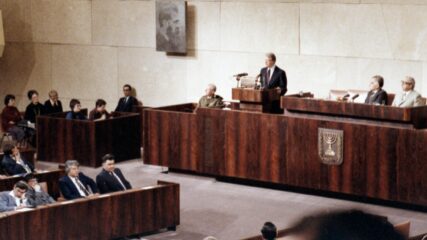
Moshe Dayan’s Remarks to the Knesset About the 1978 Camp David Accords

Moshe Dayan’s Remarks to the Knesset About the 1978 Camp David AccordsCIE+

Dayan made the case to the knesset that it should vote in favor of the Camp David Accords stipulating why doing so would be in Israel’s long term interest. He stated specifically that there was no promise for a Palestinian state, IDF forces would remain in the West Bank, negotiations for a peace treaty would continue, and these agreements were signed by the President of Egypt and the President of the US.

Documents and Sources|September 29, 1978
Protocol of Conversation Among President Carter, Prime Minister Begin, Secretary of State Vance, Foreign Minister Dayan and Israeli Attorney General Barak, September 1978

Protocol of Conversation Among President Carter, Prime Minister Begin, Secretary of State Vance, Foreign Minister Dayan and Israeli Attorney General Barak, September 1978CIE+

This document is the only known official written transcript of the Begin-Carter discussion held at the end of the 1978 Camp David negotiations about any moratorium on Israel’s future settlement building. This record shows that Begin made no mention of a moratorium on settlement building for longer than three months. However, President Carter publicly, and Secretary of State Vance, in his memoirs, Hard Choices disagreed, believing the time mentioned was five years. For the remainder of Carter’s presidency, and for the rest of his post-presidency, the ‘building of Israeli settlements’ became a key point of contention in shaping his relationship with Israel.

Documents and Sources|September 20, 1978
Camp David Accords, 1978

Camp David Accords, 1978

With President Carter mediating, Sadat and Begin agree to two outlines: a framework for a treaty between them and to define Palestinian “autonomy,” not self-determination or a state for them.

Documents and Sources|September 17, 1978
U.S., Israeli Negotiators at Camp David Discuss Resolution 242, September 16, 1978

U.S., Israeli Negotiators at Camp David Discuss Resolution 242, September 16, 1978CIE+

U.S. and Israeli officials at Camp David spend a session focused on the land-for-peace U.N. Security Council Resolution 242 and how it applies to the West Bank, Jordan, Israel and the Palestinians. Appropriate for a discussion over 242, whose application depends on the absence of the word “the,” the officials argue over using boundary, border, line, borderline or something else.

Documents and Sources|September 16, 1978
Secretary of State Cyrus Vance Meets With Israeli Delegation at Camp David, September 14, 1978

Secretary of State Cyrus Vance Meets With Israeli Delegation at Camp David, September 14, 1978CIE+

This meeting between Secretary of State Cyrus Vance and the Israeli delegation exemplified the injection of US interests and the application of concerted diplomatic pressure on Israel. The Israeli delegation at Camp David repeatedly refused the Carter administration’s vigorous efforts to introduce new formulations that might ultimately result in a Palestinian state.

Documents and Sources|September 14, 1978
Memorandum of Conversation of Israeli Foreign Minister Moshe Dayan and Defense Minister Ezer Weizman With U.S. Secretary of State Cyrus Vance and Secretary of Defense Harold Brown at Camp David, September 7, 1978

Memorandum of Conversation of Israeli Foreign Minister Moshe Dayan and Defense Minister Ezer Weizman With U.S. Secretary of State Cyrus Vance and Secretary of Defense Harold Brown at Camp David, September 7, 1978CIE+

Early during the Camp David summit, Moshe Dayan, Ezer Weizman and other Israeli officials address resettlement and payment of 1967 and 1948 Palestinian refugees and Israeli military redeployment on the eastern and western borders, while Zbigniew Brzezinski, Cyrus Vance and other Americans emphasize Palestinian sovereignty.

Documents and Sources|September 7, 1978
Jimmy Carter’s Unbridled Praise for the Shah of Iran at a State Dinner in Tehran, 1977 

Jimmy Carter’s Unbridled Praise for the Shah of Iran at a State Dinner in Tehran, 1977 CIE+

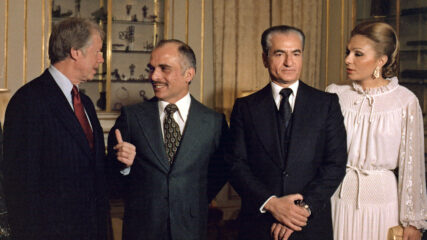
Having made human rights a central pillar of his foreign policy, Carter nonetheless seemingly ignored the abuses the Shah of Iran imposed upon his own people. Carter’s unctuous praise for the Shah at this state dinner angered Iranians in general, the clerical regime that replaced the Shah in 1979, resulting in negative consequences for Carter as he went into the 1980 presidential election.

Documents and Sources|December 31, 1977
Memorandum of Conversation Between President Carter and President Assad, 1977

Memorandum of Conversation Between President Carter and President Assad, 1977CIE+

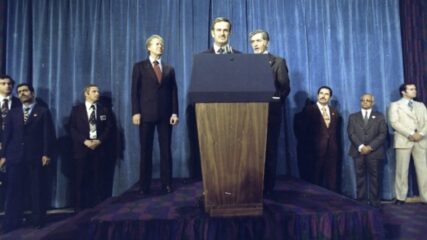
This meeting was the only one between U.S. President Carter and Syrian President Assad during the Carter administration. Carter wanted to learn Assad’s requirements for an agreement with Israel. Assad doubted that the Saudis would join this process. In the end, Assad made it clear that he was not rushing into an agreement with Israel, even if asked by the United States. Carter acknowledged knowing little about the Palestinian refugee issue and said the U.S. was committed to the security of Israel.

Minutes of a Policy Review Committee Meeting About the Middle East, 1977

Minutes of a Policy Review Committee Meeting About the Middle East, 1977CIE+

When the Carter Administration entered office in 1977, an early foreign policy priority was to kick-start Middle East negotiations. In this Policy Review Committee Meeting, Carter’s staff proposed a negotiating outcome that would pass through a conference, including the withdrawal of Israel’s forces to almost the 1967 borders, bringing the PLO into talks as Palestinian representatives, all the while seeking to uphold Israel’s security requirements.

Documents and Sources|April 19, 1977