Cards List
FILTERED BY:
<span class="cie-plus-title">Summary of President Jimmy Carter’s Meetings With King Hussein, 1980</span><span class="cie-plus-badge">CIE+</span>

Summary of President Jimmy Carter’s Meetings With King Hussein, 1980CIE+

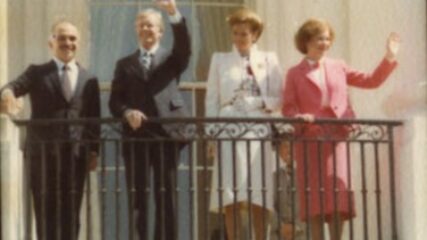
After the September 1978 Camp David Accords ended, the Carter administration diligently tried but failed to persuade Jordan’s King Hussein to be part of the follow-on negotiations over Palestinian autonomy. Carter felt Hussein was obstructionist; Hussein did not believe in 1978 that the US could halt Israeli settlement building as promised then. Hussein was correct. He also believed that Palestinian Autonomy might have a negative impact on many Palestinians living in his kingdom. Hussein was skeptical of the US capacity to negotiate for his national interests. At the same time, privately, Egypt’s Sadat was not displeased that the Jordanians remained out of favor with the US, and away from any negotiations that would detract from implementation of Israel’s promised full withdrawal from Sinai, per their 1979 Treaty. In 1988, Hussein stepped away from the West Bank’s future; in 1994, Jordan signed a peace treaty with Israel.

Documents and Sources|June 16 and 17, 1980
CIA Assessment, March 1980: Iran’s Aggressive Ideology Aims to Reshape the Middle East; Why Did the Carter Administration Not Understand the Islamic Clergy’s Intentions 18 Months Earlier?

CIA Assessment, March 1980: Iran’s Aggressive Ideology Aims to Reshape the Middle East; Why Did the Carter Administration Not Understand the Islamic Clergy’s Intentions 18 Months Earlier?

The CIA report details Iran’s aggressive foreign policy of promoting Islam as a radical platform for governance, noting also the new regime’s vigorous anti-U.S. outlook. Viewing Iran exclusively as an asset in the Cold War and not comprehending the potential power of political Islam developing with Iran proved to be one of the greatest oversights in U.S. Middle East foreign policy in the last 100 years.

<span class="cie-plus-title">U.N. Security Council Resolution 465 on Jerusalem, Settlements and Territories, 1980</span><span class="cie-plus-badge">CIE+</span>

U.N. Security Council Resolution 465 on Jerusalem, Settlements and Territories, 1980CIE+

Showing its public opposition to Israeli actions in the lands taken in the June 1967 war, an area that the Carter Administration
wanted reserved for Palestinian self-rule, it ‘strongly deplores’ Israel’s settlement policies. Passage of the resolution three weeks
prior to the New York and Connecticut presidential primaries, cause many Jewish voters to vote in favor of Ted Kennedy
and not for Carter, helping to splinter the Democratic Party.

Documents and Sources|March 1, 1980
<span class="cie-plus-title">Conversation Between U.S. National Security Adviser Zbigniew Brzezinski and Saudi Prince Fahd on Camp David Accords and Other Regional Issues, March 1979</span><span class="cie-plus-badge">CIE+</span>

Conversation Between U.S. National Security Adviser Zbigniew Brzezinski and Saudi Prince Fahd on Camp David Accords and Other Regional Issues, March 1979CIE+

Nine days before the signing of the Egyptian-Israeli treaty, U.S. National Security Adviser Zbigniew Brzezinski and Saudi Foreign Minister Prince Saud carry out an extraordinarily frank conversation. It includes bilateral relations, common fears of regional turbulence and Anwar Sadat’s estrangement from other Arab leaders.

Documents and Sources|March 17, 1979
<span class="cie-plus-title">Moshe Dayan’s Remarks to the Knesset About the 1978 Camp David Accords</span><span class="cie-plus-badge">CIE+</span>

Moshe Dayan’s Remarks to the Knesset About the 1978 Camp David AccordsCIE+

Dayan made the case to the knesset that it should vote in favor of the Camp David Accords stipulating why doing so would be in Israel’s long term interest. He stated specifically that there was no promise for a Palestinian state, IDF forces would remain in the West Bank, negotiations for a peace treaty would continue, and these agreements were signed by the President of Egypt and the President of the US.

Documents and Sources|September 29, 1978
<span class="cie-plus-title">Protocol of Conversation Among President Carter, Prime Minister Begin, Secretary of State Vance, Foreign Minister Dayan and Israeli Attorney General Barak, September 1978</span><span class="cie-plus-badge">CIE+</span>

Protocol of Conversation Among President Carter, Prime Minister Begin, Secretary of State Vance, Foreign Minister Dayan and Israeli Attorney General Barak, September 1978CIE+

This document is the only known official written transcript of the Begin-Carter discussion held at the end of the 1978 Camp David negotiations about any moratorium on Israel’s future settlement building. This record shows that Begin made no mention of a moratorium on settlement building for longer than three months. However, President Carter publicly, and Secretary of State Vance, in his memoirs, Hard Choices disagreed, believing the time mentioned was five years. For the remainder of Carter’s presidency, and for the rest of his post-presidency, the ‘building of Israeli settlements’ became a key point of contention in shaping his relationship with Israel.

Documents and Sources|September 20, 1978
Camp David Accords, 1978

Camp David Accords, 1978

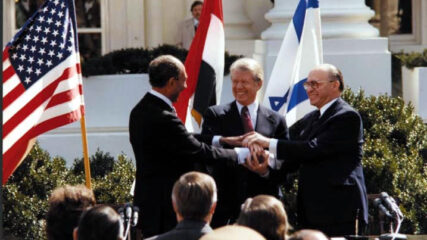
With President Carter mediating, Sadat and Begin agree to two outlines: a framework for a treaty between them and to define Palestinian “autonomy,” not self-determination or a state for them.

Documents and Sources|September 17, 1978