Cards List
FILTERED BY:
President Barack Obama’s Speech at Cairo University, 2009

President Barack Obama’s Speech at Cairo University, 2009 CIE+ members only

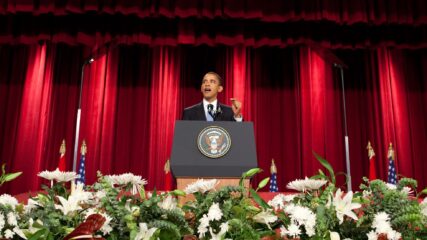
Barack Obama, while seeking to improve America’s image by urging an end to violence and stereotypes, emphasizes the need for a two-state Israeli-Palestinian solution as part of a reset of U.S. relations with the Muslim world. His advocacy of soft power distinguishes his administration from George W. Bush’s use of force. Nine years later, Donald Trump’s secretary of state, also in Cairo, heavily criticizes the Obama soft-power approach.

Annapolis: Precedents and Transactions but Not Transformations

Annapolis: Precedents and Transactions but Not Transformations CIE+ members only

Since the June 1967 war, more than two dozen mediators have engaged in Arab‐ Israeli diplomacy seeking to clarify one underlying question: under what conditions and over what period of time would Israel relinquish land attained in the June 1967 War, and what kind of understanding or agreement from an Arab partner would Israel receive in return? The Annapolis Conference in 2007, was again a Transaction but not a Transformation of Outcomes.

Mitchell Report, 2001

Mitchell Report, 2001 CIE+ members only

In the midst of severe Palestinian-Israeli clashes, a committee led by former U.S. Sen. George Mitchell concludes, as had many previous investigations, that the two communities fear and want to live separately from each other. From the report flows the EU-U.N.-U.S. commitment to a two-state solution suggested in the 2003 Roadmap for Peace.

Remarks by President Clinton at Signing of Oslo Accords, 1993

Remarks by President Clinton at Signing of Oslo Accords, 1993 CIE+ members only

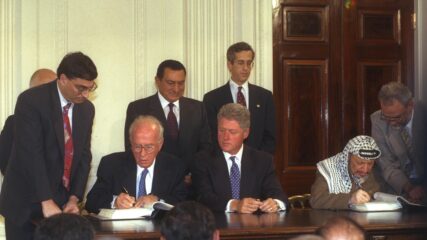
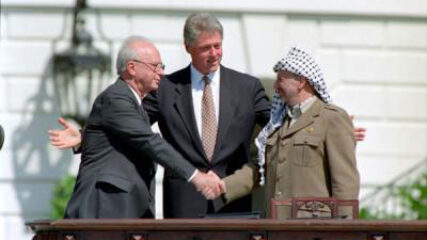
Clinton expresses gratitude to those who brought about the possibilities of reconciling Israeli and Palestinian aspirations, and acknowledges past leaders, Menachem Begin, Anwar Sadat, Jimmy Carter, and George Bush for advancing the sides toward this moment of signing the Accords on Interim Palestinian Self-Government. Over the next two decades, funds pour into the West Bank and Gaza Strip and elections for a self governing authority are held, but autocratic rule and financial mismanagement prevail, stymying along with other reasons, successful Palestinian self-rule.

Documents and Sources|September 13, 1993
Khaddam: Ken Stein Interview With Syrian Vice President Abdel Halim Khaddam

Khaddam: Ken Stein Interview With Syrian Vice President Abdel Halim Khaddam CIE+ members only

From 1970 to 1984, Khaddam served as Syria’s foreign minister, and later he was Syria’s decision-maker for actions in Lebanon. He recounts Syrian anger toward Egyptian President Sadat’s slow but continual bilateral engagement and recognition of Israel. He recalls how Syrian President Assad, after a four-hour meeting, refused Henry Kissinger’s invitation to attend the 1973 Geneva peace conference, not wanting to sanction the closeness Sadat was establishing with Israel and with Washington. These were the same reasons why Syria refused President Carter’s invitation to attend a similar Middle East peace conference in 1977. Khaddam says, “We were shocked by Sadat’s actions.”

Interviews|July 18, 1993