Syria and Lebanon remain Israel’s two most proximate northern neighbors in a state of war with Jerusalem. Since the Mandate period, access to the headwaters of the Jordan River, found at the flanks of Mount Hermon in Syria/Lebanon, has complicated bilateral relations, as has foreign influence from Iran, Russia, Turkey and others. But still-unfolding political changes sparked by the Hamas-Israel war have unfrozen the status quo of perennial animosity between Israel and Syria and Lebanon.
Before Israel’s establishment, Zionists in Palestine had contacts with Lebanese and Syrian officials, seeking information about anti-Zionist attitudes and understanding of these Arab states’ military capabilities against Israel’s establishment and survival. Since 1949 and the…
Books and Documents Oren Barak, The Lebanese Army: A National Institution in a Divided Society. Albany: State University of New York, 2009. Benedetta Berti, The Ongoing Battle for Beirut: Old Dynamics and New Trends, Institute…
For more than a century, Arab and Muslim leaders have expressed hatred for Jews, Zionism and Israel, although some have pointed internally for the failures of the Palestinian Arab national movement.
Israeli Prime Minister Benjamin Netanyahu highlights strategic if incomplete achievements in wars fought since October 2023 while working to solidify his political support before fall elections.
Washington Institute Senior Fellow Michael Eisenstadt speaks about the regional effects of the 2023-2025 Hamas-Israel war and the ongoing U.S.-Israel-Iran war in March 2026.
While too much is unknown after a week of fighting to make definitive statements about the war, certain possible outcomes can be explored.
CIE President Ken Stein addresses what is and what is not known about why Hamas attacked October 7, 2023, why Israel was caught off guard, and what happens after the war across the region.
CIE President Ken Stein briefly reviews the 2023-2025 Hamas-Israel war and examines the short- and long-term consequences.
The U.S., Turkey, Qatar and Egypt commit to trying to implement President Trump’s vision for enduring peace in Gaza and the entire Middle East without offering details or obtaining the sign-on of Israeli or Palestinian officials.
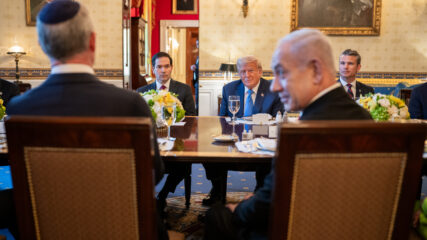
Before a White House dinner, President Trump and Prime Minister Benjamin Netanyahu talk about Gaza, Iran, Syria and Middle East peace.
May 2025 CIE has compiled the following list of books and articles to guide understanding of the modern Middle East. For a supplement to this bibliography, click on CIE’s Annotated Bibliography of Basic Books on…
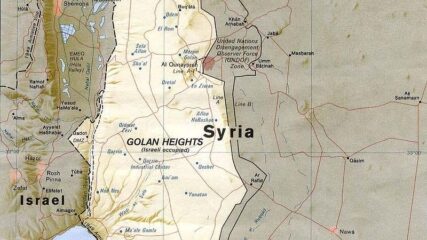
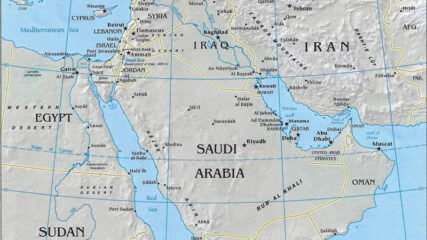
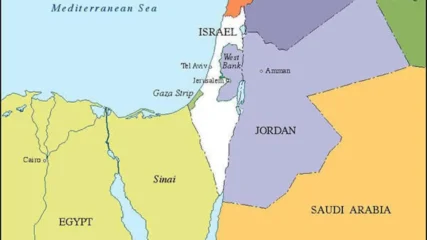
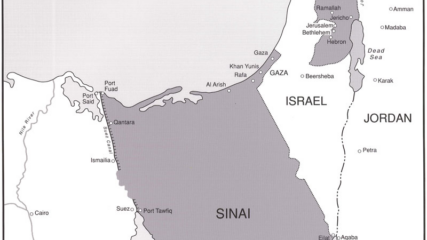
A current map showing the political borders of Israel and its nearest neighbors in the Arab world.
Netanyahu’s speech reflected on the needed elimination of Hezbollah as an enemy of Israel, a powerful militia fighting in Lebanon against Israel for four decades. On the day of Netanyahu’s speech, the Israeli Air Force killed Hassan Nasrallah, the Hezbollah leader in his Beirut offices along with other Hezbollah officials.
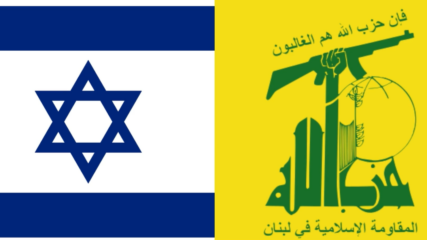
Hezbollah has used its stronghold in southern Lebanon to launch continual attacks on northern Israel since October 8, 2023. Hezbollah says it is motivated by its support for Hamas, a fellow member of Iran’s Axis of Resistance surrounding Israel. While Hezbollah is Shia and Hamas is Sunni, both are devoted to Israel’s destruction, and both receive funding from and coordinate with Iran.
February 2024 Washington Institute for Near East Policy Since the Hamas-led attacks against Israel on October 7, 2023, Hezbollah Secretary-General Hassan Nasrallah has made five public appearances to address the group’s own confrontation with Israel…
October 25, 2023 After Hamas terrorists murdered more than 1,200 Israelis and others and kidnapped at least 240 on Oct. 7, 2023, Israel’s military responses unfolded. Political and emotional reactions erupted across the region and…
Enormous tension and risks taken by Egyptian and Israeli leaderships are recounted in a brief chronology of events that led to the June 1967 war, a benchmark turning point in Middle Eastern, Israeli, and Jewish history.
This 54-minute webinar, recorded Oct. 27, 2021, is part of the Center for Israel Education’s “Israel in Context” series and is incorporated into an extensive set of documents, study guides, videos and other resources CIE has compiled at https://israeled.org/madrid-conference/ to mark the 30th anniversary of the Madrid Middle East Peace Conference, when Israel first sat at the same table with all of its immediate Arab neighbors to talk peace.
Historical Context Explore the historical context through the events and the documents leading up to the 1991 Madrid Middle East Peace Conference: 1949: Israel ends the War of Independence without secure borders or Arab acceptance….
The clash of great powers to control the Middle East, particularly between the U.S. and the U.S.S.R., neither began after World War II nor ended with the demise of the Soviet Union in 1991. Today, China, the U.S., Russia and Middle Eastern regional powers vie to influence everyday politics and resources.
The waves of protests in Lebanon in recent weeks and the country’s political instability stem primarily from fundamental problems in the local economy, including the absence of reforms and the rampant corruption among the ruling elite and all government institutions. These developments are highly problematic for the country’s decision makers, including Hezbollah. Israel, for its part, is monitoring the developments, which inter alia could lead to a strengthening of Hezbollah.
July 12, 2019 will mark the thirteenth anniversary of the outbreak of the Second Lebanon War; August 14 will mark the anniversary of its end under Security Council Resolution 1701; and discussions will be held at the United Nations headquarters regarding a renewal of UNIFIL’s mandate for another year. The bottom line: another war between Israel and Lebanon did not erupt, mainly due to both sides’ desire to avoid it and, to some extent, also due to UNIFIL’s help in preventing escalation resulting from tactical incidents.
On March 25th 2019, President Trump signed an order for the United States’ official recognition of Israeli sovereignty over the Golan Heights. This article surveys Israeli public opinion regarding this issue, and its reactions to this announcement. Surveys have shown a consistently high level of support among Jewish Israelis for keeping the Golan Heights, and while there is some disagreement – Jews across the political spectrum support President Trump’s decision.
U.S. President Donald Trump recognizes Israeli sovereignty over the Golan Heights more than 37 years after Israel annexed the mountains.