Cards List
FILTERED BY:
<span class="cie-plus-title">Summary of President Jimmy Carter’s Meetings With King Hussein, 1980</span><span class="cie-plus-badge">CIE+</span>

Summary of President Jimmy Carter’s Meetings With King Hussein, 1980CIE+

After the September 1978 Camp David Accords ended, the Carter administration diligently tried but failed to persuade Jordan’s King Hussein to be part of the follow-on negotiations over Palestinian autonomy. Carter felt Hussein was obstructionist; Hussein did not believe in 1978 that the US could halt Israeli settlement building as promised then. Hussein was correct. He also believed that Palestinian Autonomy might have a negative impact on many Palestinians living in his kingdom. Hussein was skeptical of the US capacity to negotiate for his national interests. At the same time, privately, Egypt’s Sadat was not displeased that the Jordanians remained out of favor with the US, and away from any negotiations that would detract from implementation of Israel’s promised full withdrawal from Sinai, per their 1979 Treaty. In 1988, Hussein stepped away from the West Bank’s future; in 1994, Jordan signed a peace treaty with Israel.

Documents and Sources|June 16 and 17, 1980
<span class="cie-plus-title">The Problem of Rafah: Prime Minister Menachem Begin’s Letter to Shlomo Goren, 1981</span><span class="cie-plus-badge">CIE+</span>

The Problem of Rafah: Prime Minister Menachem Begin’s Letter to Shlomo Goren, 1981CIE+

Prime Minister Menachem Begin argues for the return of Rafah to Egypt; the greater purpose is implementation of the Egyptian-Israeli Treaty, which also meant Israel”s withdrawal from settlements in Sinai near Rafah. Egypt in treaty negotiations with Israel, did not want to have the Gaza Strip again under their administration as they had between 1949 until after the June 1967 War

Documents and Sources|August 17, 1981
<span class="cie-plus-title">Mark Siegel Resignation Letter and Conversation With President Carter, 1978</span><span class="cie-plus-badge">CIE+</span>

Mark Siegel Resignation Letter and Conversation With President Carter, 1978CIE+

Siegel resigned over two matters: the administration’s policy of selling advanced fighter aircraft to Saudi Arabia and Egypt, which he believed a threat to Israel’s national security, and his sharp disagreement with the Carter White House for not allowing alternative views on policy matters to find their way to the President’s desk. Siegel’s detailed interview about the administration’s anti-Israeli viewpoints are explained here.

Documents and Sources|March 8 and 9, 1978
<span class="cie-plus-title">President Jimmy Carter, “The Camp David Accords,” Address to Congress, 1978</span><span class="cie-plus-badge">CIE+</span>

President Jimmy Carter, “The Camp David Accords,” Address to Congress, 1978CIE+

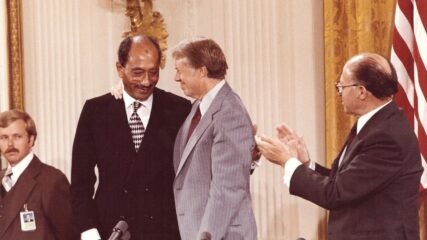
The Camp David accords culminated after thirteen days of intense negotiations between Israeli, Egyptian, and American delegations. Egyptian and Israeli leaders met with President Carter where after difficult negotiations they signed two accords, one an outline for an Egyptian-Israeli Treaty and one for Palestinian self-rule. The negotiations continued for another six months until the Egyptian-Treaty was signed in March 1979, after considerable bad feeling was tossed back and forth between Israeli and American negotiators.

Documents and Sources|July 26, 2023
<span class="cie-plus-title">Jimmy Carter’s Decade of Embracing Hamas, 2003-2015</span><span class="cie-plus-badge">CIE+</span>

Jimmy Carter’s Decade of Embracing Hamas, 2003-2015CIE+

Former US President Jimmy Carter embraced Hamas as a legitimate voice of the Palestinian people. His motivations possibly stretched from intentional to misguided to malevolent. Hamas leaders who were engaged in inter-Palestinian struggles remained pleased with the recognition he gave them. American officials and Israelis were keenly perturbed by the courtship he gave them.