Assembled here are key sources that have shaped the modern Middle East, Zionism and Israel. We have included items that give texture, perspective and opinion to historical context. Many of these sources are mentioned in the Era summaries and contain explanatory introductions.
This document was secured at the Central Zionist Archives in Jerusalem. Less than a year before Hitler invaded Poland, Arab leaders with an interest in Palestine are starkly disappointed that the the German government did not go to war against the Zionists in Palestine. The same leaders give the Zionist national builders high marks for their perseverance against terrorist bands in the Palestinian countryside. They worry that unless Arab states come to the Palestinians’ assistance, Palestine will be lost to the Zionists. A remarkable assessment for Palestinian Arab leaders and their supporters.

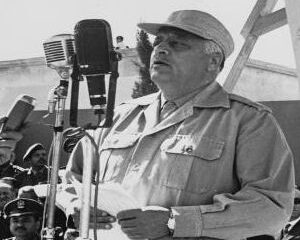
Israeli Chief of Staff Moshe Dayan’s eulogy in 1956 for an Israeli guard murdered at a kibbutz next to the Gaza Strip affirms absolute requirements for being an Israeli: vigilance, determination, and not to be fooled by hollow claims for peace.
Palestine Liberation Organization seeks Israel’s destruction through armed struggle. It retains this stated policy until December 1988.
Since its inception in 1988, Hamas has been crystal clear about its total opposition to Zionism and Israel. It opposes any kind of negotiations or agreements that recognize Israel as a reality, and its more extreme spokesmen regularly incite or celebrate the killing of Jews.
As a militant Islamic Palestinian national organization, Hamas believes that Israel is illegitimate and should be destroyed through Jihad. Hamas opposes all recognition and negotiation with Israel and opposes PLO/PA leaders who have negotiated and collaborated with Israel from time to time. The Hamas-PA competition severely fragments the Palestinian political community.
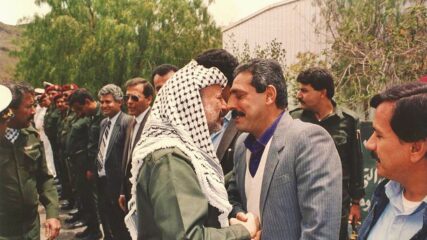
PLO Chairman Yasser Arafat issues a declaration with five American Jewish leaders in an effort to meet U.S. conditions for dialogue and thus strengthen his position as the leader of the Palestinian national movement.
Secretary of State James A. Baker III brings a realistic and prescient vision of Arab-Israeli peace negotiations and U.S. mediation to AIPAC early in the George H.W. Bush presidency.
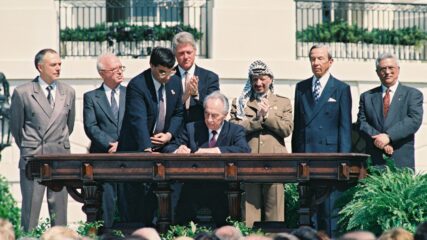
In September 2023, thirty years after the historic signing of the Oslo Accords, there is occasion to review Prime Minister Rabin’s understanding of them. I assembled this collection years ago from Daily Reports- Near East and South Asia, 1993-1995. Two short items about Rabin’s views are also found or linked here. Rabin provided a summary of his views of the Accords in a Knesset speech in October 5, 1995. Some of Rabin’s reasons for signing the Accords are also provided in Yehuda Avner’s The Prime Ministers.
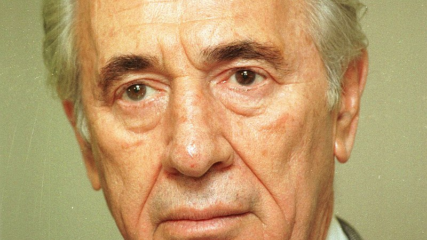
Foreign Minister Shimon Peres supports the Oslo Accords, opposes a Palestinian state and rejects Israel’s role in the Gaza Strip as the enforcer of security — all views that have continuing relevance for Gaza.
Days before his assassination, Yitzhak Rabin explains that he accepted the Oslo Accords and shook Yasser Arafat’s hand because the PLO represented the last hope for a secular Palestinian nationalism amid the rise of Hamas.
The Israeli investigation concludes that Yigal Amir is Rabin’s assassin. The Commission does not assess the impact on the assassin of the vicious language directed at Rabin for signing the Oslo Accords.
In the midst of severe Palestinian-Israeli clashes, a committee led by former U.S. Sen. George Mitchell concludes, as had many previous investigations, that the two communities fear and want to live separately from each other. From the report flows the EU-U.N.-U.S. commitment to a two-state solution suggested in the 2003 Roadmap for Peace.
CIA Director George Tenet proposes a cease-fire to stop vicious Palestinian-Israeli violence that carries on for four more years. The plan seeks to restore Palestinian-Israeli security cooperation, end incitement, arrest militants and establish mechanisms for accountability through the U.S.
The findings of the Or Commission on the October 2000 clashes between Arab and Jewish Israelis provide context to the response of Arab citizens to the May 2021 Israeli-Palestinian fighting.
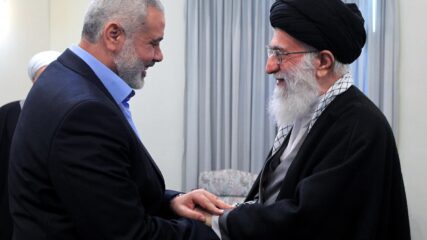
Hamas leader Ismail Haniyeh says in Tehran, “We shall never recognize the usurper Zionism government” and will “continue the jihadist movement until the liberation of Jerusalem.”
Delivering the third address by a U.S. president to the Knesset, George W. Bush celebrates Israel’s 60th birthday by emphasizing the enduring U.S.-Israel relationship based on shared values.
Biden’s is seized by Iran’s nuclear weapons program, and its continued support of terrorist organizations, like Hezbollah and Hamas; they endanger Israel and the world. Golda Meir told him. “Israel’s secret weapon; it has no place to go.”
Hamas has opposed all agreements and cooperation which either the PLO or the Palestinian Authority have signed with Israel. “Hamas will never recognize Israel. This is a red line that cannot be crossed.
As it has in the past Hamas may accept a tahdi’a or calming down of tensions, or even a temporary truce or hudna, negotiated by a third party, but for it to accept Israel as a reality is totally contrary to its ideological outlook.
Just as al-Qaeda seeks the total destruction of western democracies, Hamas seeks Israel’s total demise. Since its inception in 1988, Hamas has been crystal clear about its opposition to Zionism and Israel.
Following two weeks of Israeli-Hamas fighting, it calls for a cease-fire, and for a “lasting solution to the Israeli-Palestinian conflict by peaceful means.” The Hamas-Israeli war occurs again in 2013-2014.
The general principles are restated as they are in the 1988 founding Hamas Charter, jihad is the means to liberate Palestine, with an important notable addition, that these principles include ‘no recognition of the Zionist entity,’ for their point of view a terrible PLO recognition in September 1993. This document also restated the Palestinian right of return to all of Palestine defined as from the Jordan River on the east to the Mediterranean Sea.
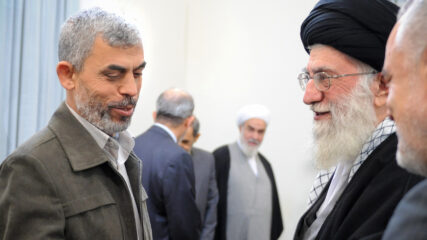
Yahya Sinwar, the Hamas leader in Gaza and mastermind of the October 7 attack, repeatedly expressed his desire to destroy Israel and his gratitude for Iran’s support.
Former US President Jimmy Carter embraced Hamas as a legitimate voice of the Palestinian people. His motivations possibly stretched from intentional to misguided to malevolent. Hamas leaders who were engaged in inter-Palestinian struggles remained pleased with the recognition he gave them. American officials and Israelis were keenly perturbed by the courtship he gave them.