Assembled here are key sources that have shaped the modern Middle East, Zionism and Israel. We have included items that give texture, perspective and opinion to historical context. Many of these sources are mentioned in the Era summaries and contain explanatory introductions.
In an impassioned Knesset speech, Menachem Begin staunchly opposes accepting $1.5 billion in German reparations for Jewish deaths during WWII. No price, he believes, can be put on the lives lost.

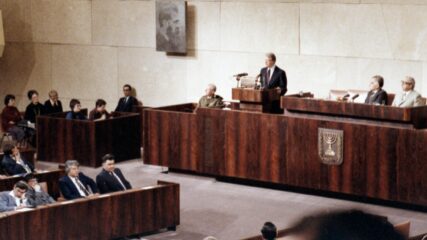
In an unprecedented presidential political gamble, President Carter meets Prime Minister Begin and then President Sadat to tie up loose ends for an Egyptian-Israeli peace treaty, signed two weeks later. During the trip, he delivers the first Knesset address by a U.S. president.
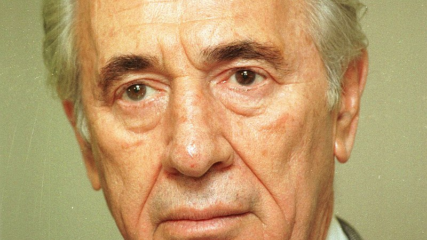
Foreign Minister Shimon Peres supports the Oslo Accords, opposes a Palestinian state and rejects Israel’s role in the Gaza Strip as the enforcer of security — all views that have continuing relevance for Gaza.
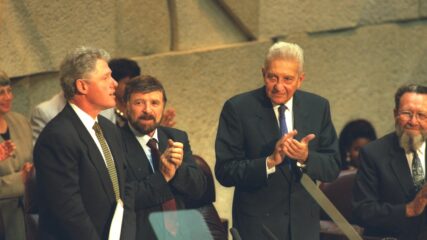
In only the second Knesset address by a U.S. president, Bill Clinton hails the treaty Jordan and Israel signed the previous day as part of a peaceful wave sweeping the region, including the year-old Oslo Accords and soon a likely treaty with Syria.
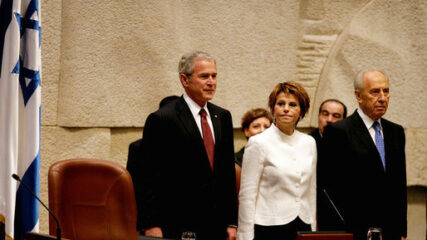
Delivering the third address by a U.S. president to the Knesset, George W. Bush celebrates Israel’s 60th birthday by emphasizing the enduring U.S.-Israel relationship based on shared values.
As the first Canadian Prime Minister to address the Knesset, Harper asserts Canada’s long-time friendship with Israel. Two days later, Canada signs a strategic cooperation agreement with Israel.
Source documents: The Israeli Knesset Debates, 1948-1981 are available online through the prodigious work of Dr. Natanel Lorch and good offices of the the Jerusalem Center for Security and Foreign Affairs. Six volumes cover this period. Each…
The most recent of Israel’s Basic Laws, the statutes enacted in place of a formal constitution, controversially asserts the Jewish nature of the state, even though almost a quarter of its citizens are not Jewish.
A former IDF general, Benny Gantz officially launches his campaign to replace Prime Minister Benjamin Netanyahu in the April 2019 election. With pride of ownership, Gantz speaks of his love of Zionism, the Jewish people and the State of Israel and cites his 38-year military career.
Israel’s Likud and Blue and White parties agree to a three-year national unity coalition government with a rotation of prime ministers (Netanyahu and Gantz) to take place after 18 months. The COVID-19 pandemic, earlier paralysis in coalition formation and President Rivlin’s urging catalyze the coalition agreement.
Prime Minister Naftali Bennett outlines and offers details for meeting domestic and foreign policy challenges facing Israel. He asks all the citizens of Israel to forge together under the banners of realism and practical solutions.
After his urging compromise on the proposed judicial overhaul, President Isaac Herzog, in the starkest of terms, says Israel is approaching the “abyss of a civil war” as opponents and proponents head toward a showdown. He characterizes the proposed overhaul as “wrong, oppressive, and undermines our democratic foundations.”
Prime Minister Golda Meir in her address to the Knesset since the beginning of the October War, recounts the war’s status on the Golan Heights and in the Suez Canal area. She reveals that an Israeli task force had crossed the Suez Canal and was fighting on the west bank of that waterway.
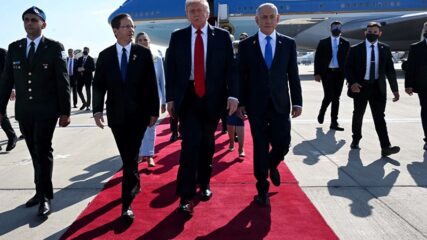
In a Knesset speech, Prime Minister Netanyahu delivers effusive praise for President Trump’s Middle East peacemaking even though the U.S. plan appears to have put the support of key Muslim powers in the region ahead of sign-on from Israeli or Palestinian officials.
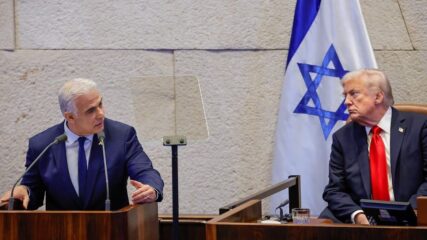
Opposition leader Yair Lapid, addressing the Knesset, praises Donald Trump for brokering the Gaza peace plan, calls on his fellow Israelis to renew their values-based democracy, and warns Israel’s enemies in the Middle East and beyond that the Jewish state is here to stay.
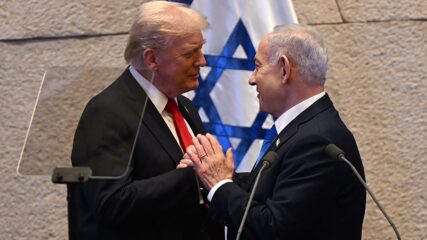
Donald Trump takes a victory lap and lays out short- and long-term visions for Gaza, Israel and the Middle East while becoming the fourth U.S. president to address the Knesset.
Former Supreme Court President Aharon Barak makes the case against the Netanyahu government’s efforts to overhaul the judiciary, arguing that Israeli democracy requires judicial independence and protection for minority rights.