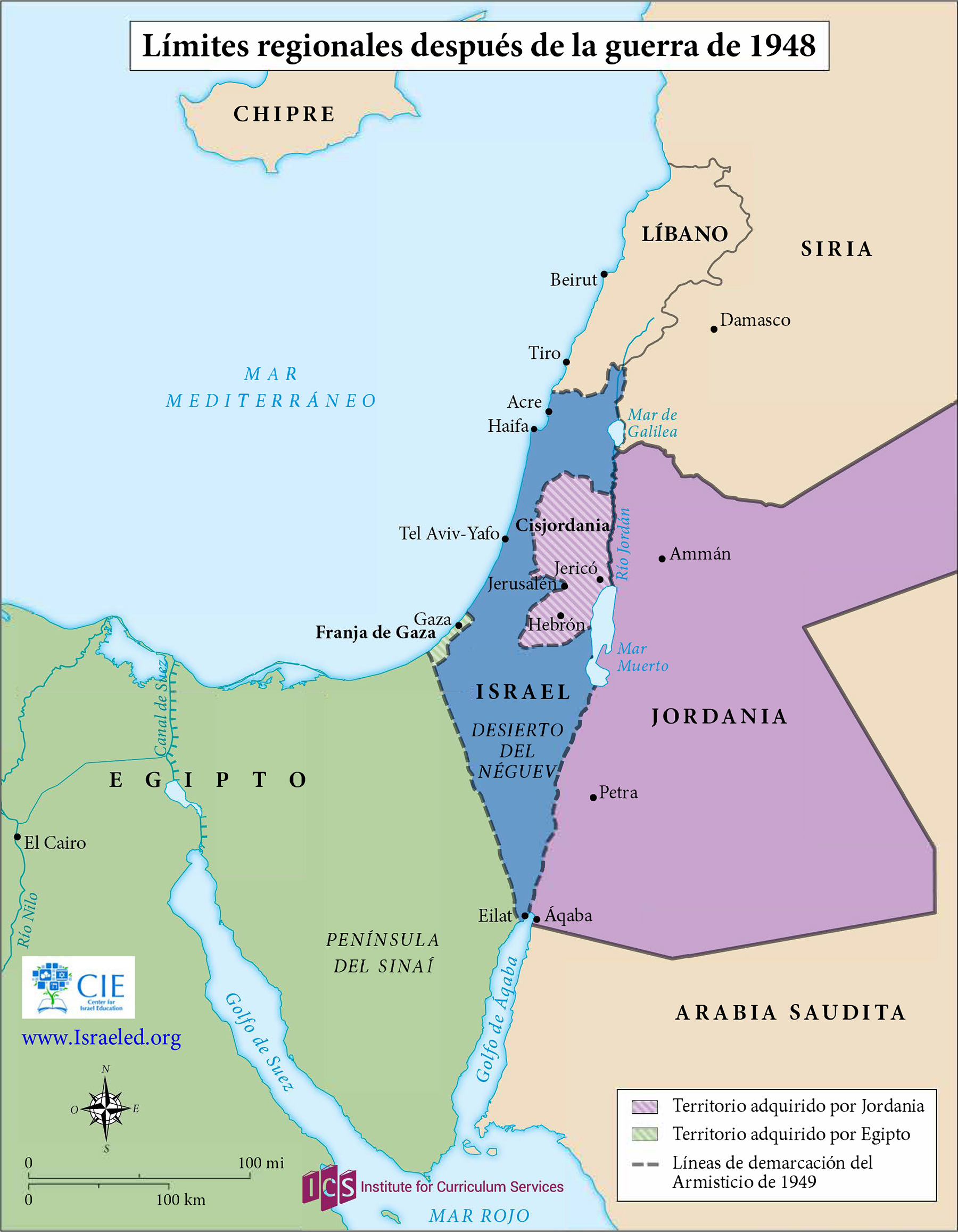
Upon Britain’s 1947 announcement that it would quit governing Palestine, communal violence between Jews and Arabs flared, but the hostilities dramatically escalated after the U.N. General Assembly voted Nov. 29, 1947, to partition Palestine into Arab and Jewish states. When the British left in May 1948 and Israel declared independence, the armies of Egypt, Syria, Transjordan, Iraq and Lebanon attacked but failed to prevent Israel’s creation.
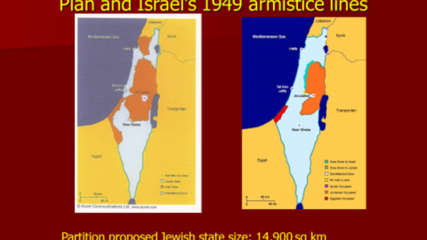
Arab states’ earlier rejection of two states and the war’s outcome had gripping consequences. The dream of creating a Jewish state was realized. No Arab or Palestinian state came into being. Israel increased its size by nearly 37% above what the U.N. plan had allocated to it. Transjordan held the West Bank and parts of Jerusalem, including the Old City, and transformed into Jordan. Egypt held the Gaza Strip. Some 700,000 Palestinian Arabs were displaced. More than 800,000 Jews fled Arab lands over the next five years as anti-Jewish sentiment soared, and most settled in Israel. Armistice agreements but no treaties were signed at the end of the war.
This map shows the territories controlled by Israel, Jordan (including the West Bank(, Lebanon, Syria and Egypt (including the Gaza Strip) at the end of Israel’s War of Independence in 1949. An Arab state was…
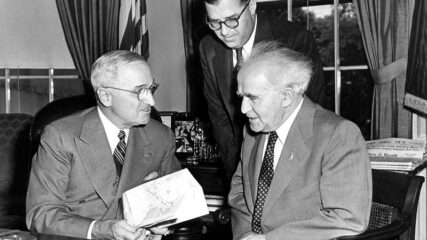
Otherwise known as Israel’s War of Independence, or, “the nakbah” or disaster to the Arab world because a Jewish state was established, the war was fought between the newly established Jewish state of Israel opposed by Palestinian irregulars, and armies from five Arab states. Official beginning of the war is usually given as May 14, 1948, the date Israel declared itself an independent Jewish state, but the war’s first of four phases began in November 1947. Lasting for two years, the war ended with armistice agreements signed in 1949 between Israel and four Arab states.

With crisp analysis, Haganah Commander Yigal Allon, later a Prime Minister of Israel attributes Israel’s successes to multiple factors including the absence of a centralized Arab command, limited Arab military training, underestimating the potential fighting capabilities of local Arabs, and Israel’s success in integrating its citizens into the war effort.

From 1898 to 1948, Zionism evolved from an idea to a concrete reality: the actual establishment of the Jewish state, Israel. Slowly, a few immigrating Jews created facts by linking people to the land. For half a century, fortuity and fortitude made the Zionist undertaking a reality. They exhibited pragmatism and gradually constructed a nucleus for a state. Through perseverance Zionists empowered themselves.

Examination of the mobilization of society for the Israeli War of Independence effort enables one to present a more extended process that began in October 1947 — some two months prior to the outbreak of the war — and ended, from the standpoint of mobilization of personnel, at the beginning of 1949, when demobilization of the first draftees from the wartime army took place, and from an economic standpoint in April 1949, when an Austerity system was declared in the State of Israel.
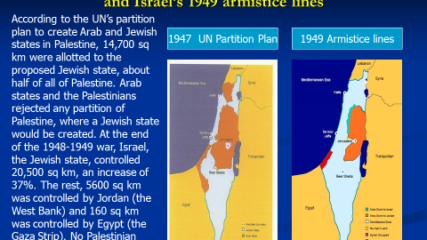
The area of Israel expanded and the potential area for a Palestinian Arab state decreased because of the 1948-49 war, Israel’s War of Independence. The Arab rejection of the 1947 U.N. partition plan thus hurt…
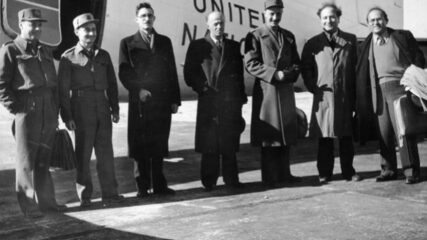
One of four agreements Israel signed in 1949 with Arab neighbors, it does not end the state of war between Israel and Egypt. They do not sign a treaty until 1979.
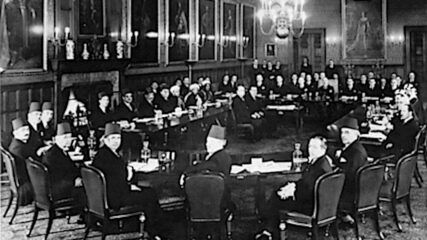
Steady disintegration of Palestinian Arab society from 1945-1949 is detailed by five Arab and non-Arab historians citing local social cleavages, economic impoverishment, fear, indebtedness, and political dysfunction.
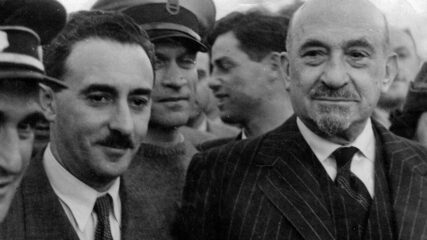
Sharett gives an overview of Israeli foreign policy, key issues, and relationships with UN and Arab states.
CIE has compiled the following list of books and articles, including some available on our website, to guide understanding of the unfolding of the Israeli War of Independence and its consequences. Books Allon, Yigal. The Making…