Israel-Egypt Peace Treaty, 1979
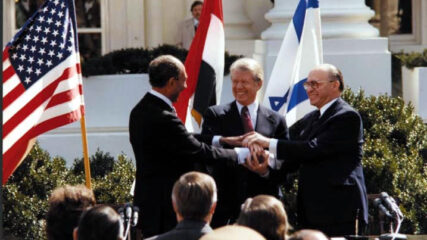
Signed sixteen months after Sadat’s visit to Jerusalem, it calls for establishment of diplomatic relations, staged Israeli withdrawal from Sinai, and American security arrangements to support the bilateral treaty.
This was the second UNSC Resolution within four months supported by the Carter administration condemning Israel’s settlement building in the territories. It too greatly angered the Israeli government and American supporters of Israel.
Showing its public opposition to Israeli actions in the lands taken in the June 1967 war, an area that the Carter Administration
wanted reserved for Palestinian self-rule, it ‘strongly deplores’ Israel’s settlement policies. Passage of the resolution three weeks
prior to the New York and Connecticut presidential primaries, cause many Jewish voters to vote in favor of Ted Kennedy
and not for Carter, helping to splinter the Democratic Party.
It calls for “recognition of the legitimate rights of the Palestinian people, a just solution to the
Palestinian problem, the right to self-determination, [and] for PLO association to the negotiations.”
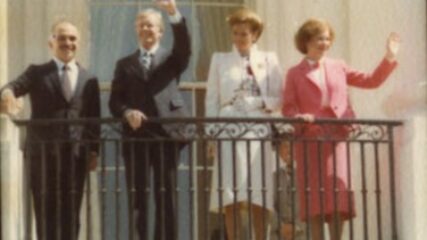
After the September 1978 Camp David Accords ended, the Carter administration diligently tried but failed to persuade Jordan’s King Hussein to be part of the follow-on negotiations over Palestinian autonomy. Carter felt Hussein was obstructionist; Hussein did not believe in 1978 that the US could halt Israeli settlement building as promised then. Hussein was correct. He also believed that Palestinian Autonomy might have a negative impact on many Palestinians living in his kingdom. Hussein was skeptical of the US capacity to negotiate for his national interests. At the same time, privately, Egypt’s Sadat was not displeased that the Jordanians remained out of favor with the US, and away from any negotiations that would detract from implementation of Israel’s promised full withdrawal from Sinai, per their 1979 Treaty. In 1988, Hussein stepped away from the West Bank’s future; in 1994, Jordan signed a peace treaty with Israel.
Failing to account for the effects on his re-election hopes, President Jimmy Carter for the second of three times in 1980 lets the U.N. Security Council enact a resolution criticizing Israeli behavior beyond the Green Line.
The United States abstains on a Security Council resolution declaring Israel’s Basic Law on Jerusalem to be in violation of international law.
Prime Minister Menachem Begin argues for the return of Rafah to Egypt; the greater purpose is implementation of the Egyptian-Israeli Treaty, which also meant Israel”s withdrawal from settlements in Sinai near Rafah. Egypt in treaty negotiations with Israel, did not want to have the Gaza Strip again under their administration as they had between 1949 until after the June 1967 War
It calls for building a mutual security relationship and for enhancing strategic cooperation to
deter Soviet threats to the region. Establishment of a consultation framework is a key to the agreement.
The United States endorses the application of U.N. Security Council Resolution 242 to the West Bank and Gaza, seeks Palestinian control over land and resources, and wants the territories to be affiliated with Jordan.
Israel and Lebanon agreed to a treaty in 1983 through U.S. mediation, only for Syria’s dominance and Lebanon’s dysfunction to block ratification.
Areas of bilateral political and military cooperation are noted to fend off Soviet involvement in the Middle East, to assist Israel in building the Lavi aircraft, to support an independent Lebanon and to promote Arab-Israeli negotiations.
The deal to mutually phase out tariffs on manufactured goods over a decade is the first free-trade agreement for the United States and the second for Israel, after one reached with a precursor to the European Union.
The Jordanian king and Israeli Labor Party leaders secretly outline a plan to convene an international conference to move Israeli-Palestinian talks forward through a conference format, but Likud opposition leaders squash the idea.
The agreement affirms the close relationship between the U.S. and Israel based on common goals, celebrates the 3-year-old U.S.-Israel Free Trade Agreement, and institutes multiple regular meetings between Israeli and U.S. officials.
Jordan’s King Hussein made a strategic decision to disassociate administratively from the West Bank, leaving it to focus Jordanian national identity on only the east bank of the Jordan River. The PLO subsequently negotiated with Israel to rule over some of these lands, as codified in the 1993 Oslo Accords, but no Palestinian state was promised.
In the waning days of the Reagan administration, Secretary of State George Shultz pushes for U.S.-mediated peace negotiations, including Palestinians, and offers the outlines for a resolution to the conflict.
PLO Chairman Yasser Arafat issues a declaration with five American Jewish leaders in an effort to meet U.S. conditions for dialogue and thus strengthen his position as the leader of the Palestinian national movement.
Secretary of State James A. Baker III brings a realistic and prescient vision of Arab-Israeli peace negotiations and U.S. mediation to AIPAC early in the George H.W. Bush presidency.
U.S. Secretary of State James Baker warns that the United States will not accept Saddam Hussein’s erasure of Kuwait a month earlier. Baker says intimidation and force will not be tolerated in the post-Cold War world.
As part of the preparations for the Madrid peace conference in October 1991, U.S. Secretary of State James Baker drafts a memorandum of agreement between the U.S. and Israel regarding the particulars of resuming the Arab-Israeli peace process. He opens by reiterating that the intention of the negotiations is to achieve a regional peace agreement based on U.N. Security Council Resolutions 242 and 338.
After the 1991 Gulf War, the US orchestrates a conference with Israel, multiple Arab states, and Palestinians participating; the conference leads to bilateral and multilateral negotiations.
The U.N. General Assembly overwhelming reverses a Soviet-driven decision 16 years earlier to declare Zionism a form of racism.
Four days before signing the Oslo Accords, the PLO and Israel recognize each other. Israel’s
Rabin worries about the growth of Hamas influence, thus elevates the PLO through international recognition.