Cards List
FILTERED BY:
<span class="cie-plus-title">Explainer: The Arab-Israel War of 1948 — A Short History</span><span class="cie-plus-badge">CIE+</span>

Explainer: The Arab-Israel War of 1948 — A Short HistoryCIE+

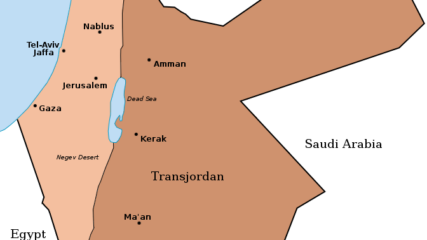
Otherwise known as Israel’s War of Independence, or, “the nakbah” or disaster to the Arab world because a Jewish state was established, the war was fought between the newly established Jewish state of Israel opposed by Palestinian irregulars, and armies from five Arab states. Official beginning of the war is usually given as May 14, 1948, the date Israel declared itself an independent Jewish state, but the war’s first of four phases began in November 1947. Lasting for two years, the war ended with armistice agreements signed in 1949 between Israel and four Arab states.

<span class="cie-plus-title">Great Britain — Palestine: Termination of the Mandate, 1948</span><span class="cie-plus-badge">CIE+</span>

Great Britain — Palestine: Termination of the Mandate, 1948CIE+

This 10-page report, written by the British Colonial and Foreign Office, along with the 1937 Peel (Royal) Commission Report, is one of the two best summaries of the British presence in Palestine.  Both are substantial in terms of content, detail and analyses; both were written from Britain’s perspective. Read these along with 1931 Census for Palestine to have a fuller grasp of the politics and the populations that shaped Britain’s Palestine’s administration from 1918-1948

.

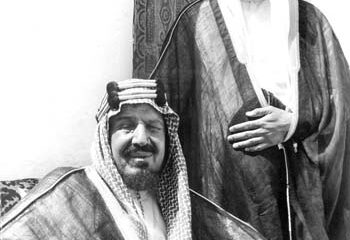
Saudi King Abdul Aziz Ibn Saud to President Truman, 1947

Saudi King Abdul Aziz Ibn Saud to President Truman, 1947

No document better reveals the hostility which most Arab leaders and Arab states had in 1947 for Zionism and for a possible Jewish state. The Saudi King notes “that US support for Zionists in Palestine is an unfriendly act directed against the Arabs.” The King’s views were totally supported by US State Department officials including Loy Henderson and George Kennan who advocated strongly against Truman’s support of a Jewish state.

<span class="cie-plus-title">Loy Henderson, State Department Director of Near Eastern and African Affairs, Vehemently Opposes Jewish State in Memo to Secretary of State George Marshall, 1947</span><span class="cie-plus-badge">CIE+</span>

Loy Henderson, State Department Director of Near Eastern and African Affairs, Vehemently Opposes Jewish State in Memo to Secretary of State George Marshall, 1947CIE+

Loy Henderson, Director of the Office of Near Eastern and African Affairs, U.S. State Department, to U.S. Secretary of State George Marshall
Writing two months before the U.S. voted at the United Nations in favor of Palestine’s partition into Arab and Jewish states, Henderson voices profound dislike for Zionism and a Jewish state. He advocates for cultivating positive relations with Muslim and Arab states. He is one of many at the State Department at the time who saw Zionism as contrary to American national interests.

Documents and Sources|September 22, 1947
<span class="cie-plus-title">Memorandum on the Administration of Palestine, June 1947</span><span class="cie-plus-badge">CIE+</span>

Memorandum on the Administration of Palestine, June 1947CIE+

Published by the British Administration of Palestine, this summary emphasizes attempts at impartiality in governing the Mandate. It notes that in 1922, the Jewish community already possessed ‘national’ characteristics, while the Arab community’s composition was sociologically and economically divided and to a large degree impoverished by the war.

1947 Truman Doctrine

1947 Truman Doctrine

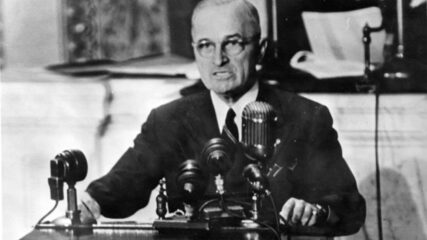
Fearing Communist penetration of the Eastern Mediterranean, Truman at the beginning of the Cold War defines the region as a sphere of US national interest.

<span class="cie-plus-title">Pro-Zionist Remarks by Winston Churchill, 1939</span><span class="cie-plus-badge">CIE+</span>

Pro-Zionist Remarks by Winston Churchill, 1939CIE+

Over four decades, Winston Churchill’s views on Zionism and Jews varied greatly. Without knowing his long held personal beliefs or the policies he adopted while the Jewish state developed, and only reading this speech, one would not know that he was a political opportunist and certainly not a “Gentile Zionist.”

<span class="cie-plus-title">HMG White Paper: Statement of Policy, 1939</span><span class="cie-plus-badge">CIE+</span>

HMG White Paper: Statement of Policy, 1939CIE+

Zionist leaders—David Ben-Gurion, Chaim Weizmann and Eliezer Kaplan—learning of the British intent to limit severely the Jewish national home’s growth. Increasingly, they are also aware of the German government’s hostilities towards European Jewry.

<span class="cie-plus-title">British Government: Policy Statement/Advice Against Partition, 1938</span><span class="cie-plus-badge">CIE+</span>

British Government: Policy Statement/Advice Against Partition, 1938CIE+

Pressure from Arab leaders in states surrounding Palestine, growing instability in the eastern Mediterranean, and a firm opposition voiced by the British High Commissioner in Egypt, Miles Lampson, caused the British to withdraw the idea of resolving the Arab-Zionist conflict with a two-state solution. Instead, heavy restrictions were imposed in 1939 on the growth of the Jewish National home. Coincidently this policy statement is issued, two days after Nazi Germany attacks Jewish, homes, businesses and synagogues, in what came to be known as Kristallnacht.

Documents and Sources|November 11, 1938
<span class="cie-plus-title">1922 White Paper on Palestine</span><span class="cie-plus-badge">CIE+</span>

1922 White Paper on PalestineCIE+

With intentioned ambiguity, Britain asserts that its goal in Palestine is not to make it wholly Jewish or subordinate the Arab population. Self-determination is not promised. Britain wants to remain an umpire between the communities. Naively, it thinks it can control communal expectations and keep the peace.