Israeli Ambassador Prosor Accuses U.N. of ‘Surrealpolitik,’ 2014CIE+
Prosor accuses the UN of duplicity and hypocrisy because it is constantly critical of Israel, but not of radical Muslims for killing of Yazidis, Bahais, Kurds, and Christians.

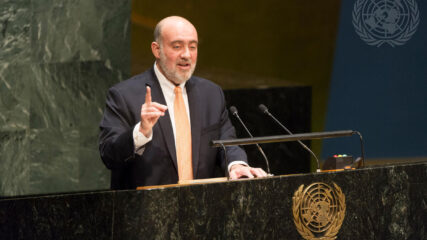
Prosor accuses the UN of duplicity and hypocrisy because it is constantly critical of Israel, but not of radical Muslims for killing of Yazidis, Bahais, Kurds, and Christians.
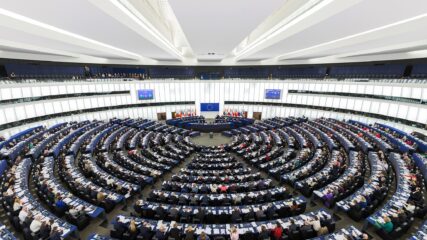
The European Parliament calls for recognition of Palestinian statehood in the context for a negotiated two-state solution for Palestinians and Israelis; it outlines the political and geographic contours for a negotiated outcome.

Kerry states five major objectives for US foreign policy in the Middle East: mobilize partners to defeat ISIS, work diplomatically to end the civil war in Syria, keep it from destabilizing friendly nearby countries, monitor Iranian adherence to the nuclear deal, and seek a two-state solution to the Palestinian-Israeli conflict.
Claiming that Israel employs a double legal standard in the West Bank, US Ambassador Dan Shapiro receives a harsh rebuke for his remarks from Israeli Prime Minister Netanyahu; Obama administration continues to chide Israel for its management of the West Bank.

With less than a month left in the Obama administration, the U.S. abstains on a Security Council resolution that blames Israel for the stalled peace process, lambastes Israeli settlements and repeatedly calls East Jerusalem occupied territory.
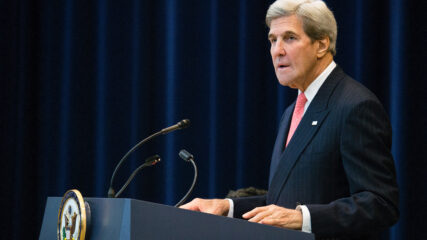
With exasperating passion, Kerry lashes out at Israel for its settlements construction as the major barrier to a two-state solution to the Israeli-Palestinian conflict.
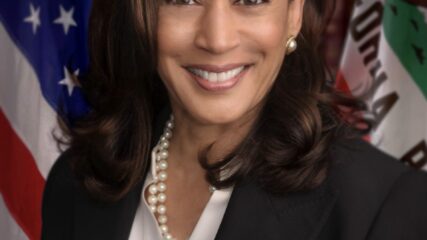
Two months into her Senate position, Harris promised “to do everything in my power to ensure broad and bipartisan support for Israel’s security and right to self-defense.” She endorsed the 10 year, $38 billion US military aid package to Israel while strongly backing (seven years before October 2023) a two-state Palestinian-Israeli solution.”
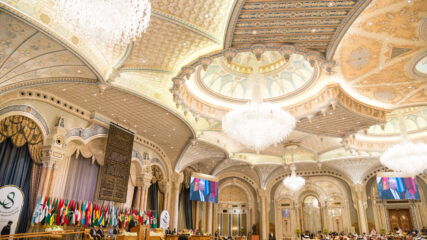
Backpedaling from previously hardline statements on Islam, President Trump refers to Islam as “one of the world’s great faiths” calling for “tolerance and respect for each other.” He implored Muslim leaders to fight against radical Islam, which he portrayed as a “…a battle between good and evil.”
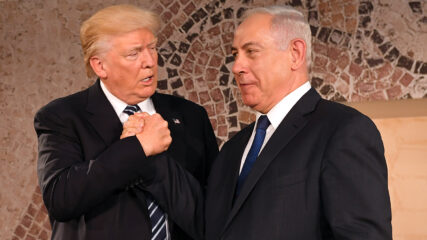
After visiting Saudi Arabia, Trump meets with Netanyahu where both assert joint views on the peace process, Iran, regional cooperation, and the long-standing relationship between Israel and the US; Trumps second meeting with Netanyahu since taking office.
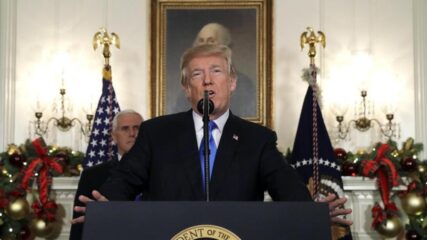
President Trump’s proclamation to “officially recognize Jerusalem as the capital of Israel” breaks precedent. In doing so, he incurs bipartisan support in the US congress, but a flurry of criticism from analysts, diplomats and foreign leaders. In his remarks, Trump rebukes claims that he disqualified the US as a “reliable mediator” in future Palestinian-Israeli negotiations.
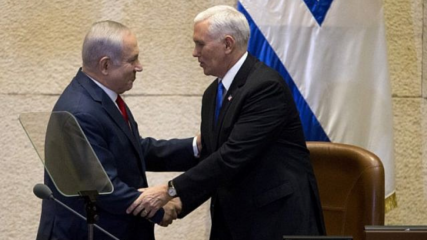
Vice President Pence firmly expresses American commitments to Israel’s security and commitment to the Arab-Israeli peace process. Palestinian Authority President Abbas and other Arab officials loudly criticize the speech and refuse to meet with Pence during his Middle East visit because of earlier US promise to recognize Jerusalem as Israel’s capital.
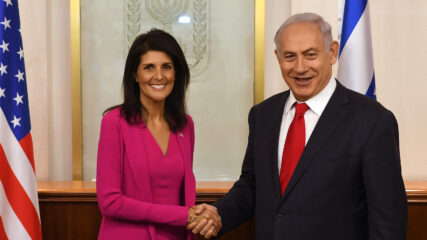
Responding to PA President Abbas’ speech at the U.N. and the PA’s rejection of the U.S. as a legitimate participant in Palestinian-Israeli negotiations, Ambassador Haley clarifies American positions on Jerusalem and the negotiating process.

Secretary of State Mike Pompeo delivers a more muscular vision of the U.S. presence in the Middle East than President Barack Obama offered in the same Cairo venue 10 years earlier.
