Jerusalem U.S.-Israel Strategic Partnership Joint Declaration, 2022
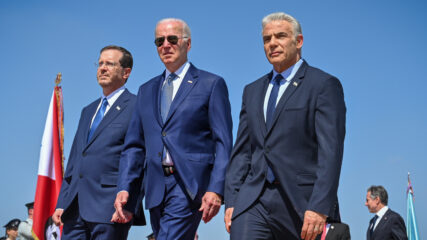
On President Joe Biden’s trip to Israel, he and Prime Minister Yair Lapid affirmed the long-term U.S.-Israel strategic relationship.
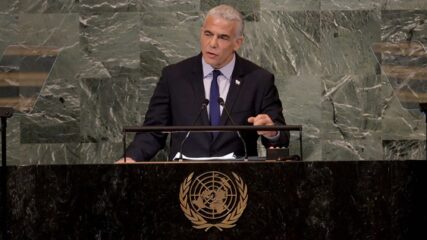
The focus of Prime Minister Yair Lapid’s first speech at the UN was a political weather report of Israel’s relations with Arab neighbors. He lauded Arab states for embracing Israel, hoped that Israel could move toward a two-state solution with the Palestinians, and blistered the hate spewing from Hamas and Iran; Israel he said, would not tolerate Iran obtaining a nuclear weapon.
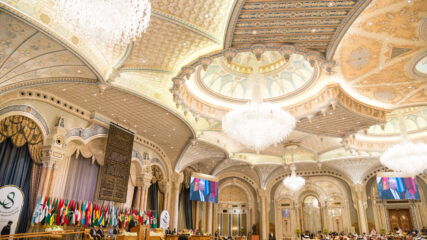
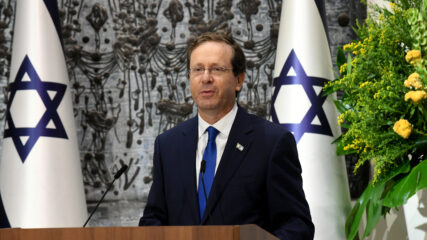
In December President Herzog visited Manama, Bahrain, his fourth visit to a Middle Eastern country in 2022, (Abu Dhabi in January, Istanbul in March, Amman in June, and Sharm El-Sheikh in November), all aimed at bolstering Israel’s economic, cultural and bi-lateral relations with Arab states. Talks on this trip focused on expanding trade and sharing among others, Israel’s solar and desalinazation technologies.
In just under an hour, Herzog emphasized the special US-Israeli relationship, citing common values between the two democracies, noting, “when the US is strong, Israel is stronger. And when Israel is strong, the US is more secure.” He cited Israel’s domestic and foreign policy challenges in its 75th year.
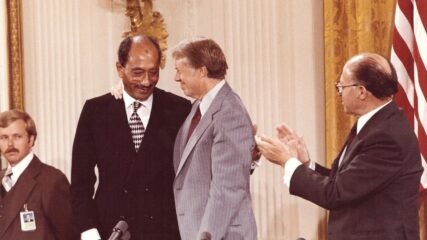
The Camp David accords culminated after thirteen days of intense negotiations between Israeli, Egyptian, and American delegations. Egyptian and Israeli leaders met with President Carter where after difficult negotiations they signed two accords, one an outline for an Egyptian-Israeli Treaty and one for Palestinian self-rule. The negotiations continued for another six months until the Egyptian-Treaty was signed in March 1979, after considerable bad feeling was tossed back and forth between Israeli and American negotiators.
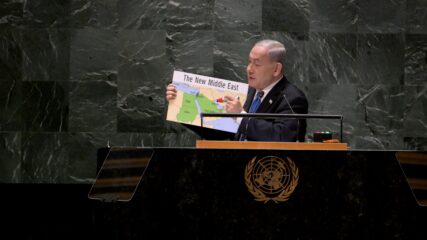
Addressing Israel’s fear of Iran’s access to nuclear weapons, the same point made by his predecessor Yair Lapid stressed in 2022 at the UN, Netanyahu like Lapid praised the Abraham Accords, noting in a quite unrestrained fashion that Israel was on the ‘cusp of a historic peace with Saudi Arabia.” The Prime Minister did mention support for a two-state solution with the Palestinians as Lapid had done previously.
Israeli Prime minister provides minimal detail for the Gaza Strip’s post war civilian restructuring, focusing entirely on immediate and long term Israeli security needs with no imposed Palestinian state nor international negotiating intervention acceptable.
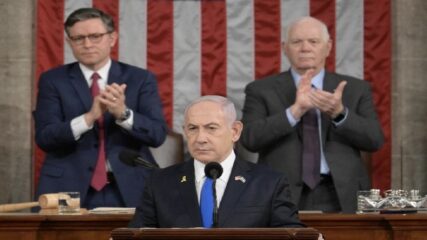
In a 52 minute speech, Netanyahu explained Israel’s absolute need for total victory in the Gaza war because Hamas and Iran were both enemies of the United States and Israel. With bi-partisan emphasis, he thanked Presidents Biden and Trump for their unwavering current and past support. Dozens of congressional members did not attend his speech, noting disagreements with the Prime Minister’s policies.
Netanyahu’s speech reflected on the needed elimination of Hezbollah as an enemy of Israel, a powerful militia fighting in Lebanon against Israel for four decades. On the day of Netanyahu’s speech, the Israeli Air Force killed Hassan Nasrallah, the Hezbollah leader in his Beirut offices along with other Hezbollah officials.
The details of the three-stage Hamas-Israel cease-fire that went into effect January 19, 2025, along with unanswered questions, insightful analyses and the relevant U.N. resolution from June 2024.
February 4, 2025 Trump Unveils Plan for U.S. Takeover of Gaza In President Donald Trump’s first meeting at the White House with a foreign leader in his second term, he welcomed Israeli Prime Minister Benjamin…
Abdullah II remains studiously noncommittal in support of Donald Trump’s idea for the U.S. to take over the Gaza Strip, rebuild it and relocate its Palestinian residents to other countries. With Jordan’s strong economic, strategic and defense ties to Washington, no one expected the king to be effusive for Trump’s suggestions for Gaza’s future. Jordan lacks the economic and demographic absorptive capacities and the political interest to take another wave of Palestinians into its territory.
Meeting in Cairo in early March 2025, the Arab League of States endorsed an Egyptian plan for the reconstruction of Gaza that was, above all else, a cleverly worded statement. The contents did not break new diplomatic ground and made no mention of Hamas or its political future. As a consensus document, it aimed at satisfying as many Arab interests and foreign ears as possible.
April 7, 2025 Source: Press conference during Prime Minister Benjamin Netanyahu’s visit to the White House and President Donald Trump, as broadcast by C-SPAN, April 7, 2025. U.S. President Donald Trump’s plan for new tariffs…
May 13, 2025 President Donald Trump’s address laying out a vision for Middle East peace and prosperity and ending sanctions on Syria at the 2025 Saudi-U.S. Investment Forum in Riyadh, Saudi Arabia, https://www.youtube.com/live/wj1QOz3iuCE?si=qQRR2GcqZhtt1F5o Well, thank…
PA President Abbas makes requests and gives promises to the French president for the establishment of a Palestinian
state. His commitments were not negotiated with Israel. They are meant to seek support for the end of the Gaza war,
the affirmation of Abbas and the PA as the sole Palestinian political address, and international support for a Palestinian state.
As in the past, the PA and Abbas seek international support to pressure Israel into undesirable political actions.
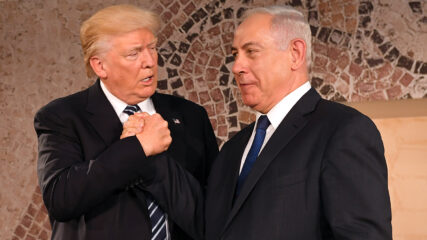
Before a White House dinner, President Trump and Prime Minister Benjamin Netanyahu talk about Gaza, Iran, Syria and Middle East peace.
Seized by the severity of the Gaza war and nonmovement on a Palestinian-Israeli negotiating process, the U.N. offers a diplomatic road map to end the war and start negotiations. Led by France and Saudi Arabia, it asserts PA primacy as the legitimate Palestinian political representative, addresses possible Palestinian governance reform, seeks to empower a sovereign and economically viable state of Palestine living side by side in security with Israel, and contains other vague PA promises. Israel and the U.S. reject the Declaration. The Israeli government refuses to have outside parties determine the outlines or pace of negotiations with any country because negotiations impact Israeli security today and tomorrow.
President Macron’s speech links the end of Hamas-Israeli conflict to the evolution of a of two-state solution. He acknowledges that Israel has the power to end the war and evolve a Palestinian state, asserting that if Israel does neither to the satisfaction of France and her European partners, Israel could pay an undisclosed price. He offers no such penalties to be placed on the PA for its failure to meet its commitments. Once again the Palestinian Arab national movement uses the international community to pressure Israel into concessions. On the same day, Israeli
Prime Minister Netanyahu emphatically rejects the establishment of a Palestinian state west of the Jordan River. The Israeli
parliament in June 2004 rejected any unilateral recognition of a Palestinian state by a 68-9 vote.
A comprehensive U.S. plan to end the Hamas-Israel war is unveiled eight days before the second anniversary of the October 7, 2023, Hamas attack.
President Trump issued a presidential order placing Qatar under the military protection of the United States. He did not submit his policy for U.S. Senate ratification, as would be necessary for the staying power of a treaty. The U.S. had never offered such protection to an Arab country, let alone one that sits across the Persian Gulf from Iran. The action was viewed as a direct response to Israel’s intrusion into Qatar’s sovereignty three weeks earlier in a failed attack on Hamas leaders in Doha. But the order might have been a step toward including Qatar in the Abraham Accords. And Qatar is potentially a key funder in rebuilding the Gaza Strip.
President Trump and Prime Minister Netanyahu explain their expansive vision for a peaceful Middle East through the implementation of a 20-point U.S. plan to end the Gaza war with the support of many Arab and Muslim countries.
October 9, 2025 Edited October 12, 2025, to add a comment from Pope Leo XIV. After negotiators meeting in Egypt reached agreement October 8, 2025, on the first phase of the 20-point U.S. plan to…
In a Knesset speech, Prime Minister Netanyahu delivers effusive praise for President Trump’s Middle East peacemaking even though the U.S. plan appears to have put the support of key Muslim powers in the region ahead of sign-on from Israeli or Palestinian officials.