<span class="cie-plus-title">President Trump’s Speech Recognizing Jerusalem as the Capital of Israel, 2017</span><span class="cie-plus-badge">CIE+</span>

President Trump’s Speech Recognizing Jerusalem as the Capital of Israel, 2017CIE+

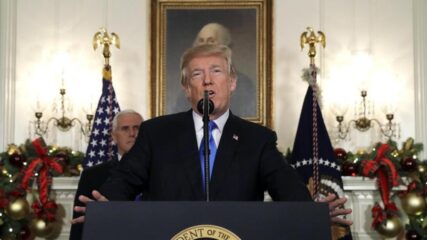
President Trump’s proclamation to “officially recognize Jerusalem as the capital of Israel” breaks precedent. In doing so, he incurs bipartisan support in the US congress, but a flurry of criticism from analysts, diplomats and foreign leaders. In his remarks, Trump rebukes claims that he disqualified the US as a “reliable mediator” in future Palestinian-Israeli negotiations.

Documents and Sources|December 6, 2017
<span class="cie-plus-title">Vice President Pence’s Speech to the Knesset, 2018</span><span class="cie-plus-badge">CIE+</span>

Vice President Pence’s Speech to the Knesset, 2018CIE+

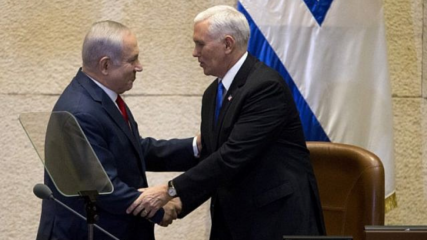
Vice President Pence firmly expresses American commitments to Israel’s security and commitment to the Arab-Israeli peace process. Palestinian Authority President Abbas and other Arab officials loudly criticize the speech and refuse to meet with Pence during his Middle East visit because of earlier US promise to recognize Jerusalem as Israel’s capital.

Documents and Sources|January 22, 2018
<span class="cie-plus-title">Volume I, Series A (1885-1902)</span><span class="cie-plus-badge">CIE+</span>

Volume I, Series A (1885-1902)CIE+

The Letters and Papers of Chaim Weizmann  Summer 1885 – 29 October 1902  Volume I, Series A, English Edition    Edited by Leonard Stein in collaboration with Gedalia Yogev, London, Oxford University Press, 1968 [Reprinted…

<span class="cie-plus-title">Volume IX, Series A (October 1918-July 1920)</span><span class="cie-plus-badge">CIE+</span>

Volume IX, Series A (October 1918-July 1920)CIE+

This volume spans the period between October 1918, when Weizmann, the head of the Zionist Commission, had just returned to England from Palestine, and July 1920, the month in which Herbert Samuel began his tenure as High Commissioner for Palestine and in which the Zionist Conference took place in London. These twenty-one months are of crucial importance for the history of Zionism and for the Jews in Palestine (the Yishuv). It is a period in which Weizmann’s ascendancy to the leadership of the World Zionist Organization becomes undisputed.

Documents and Sources|August 6, 2019
<span class="cie-plus-title">Volume X, Series A (July 1920-December 1921)</span><span class="cie-plus-badge">CIE+</span>

Volume X, Series A (July 1920-December 1921)CIE+

The dominant theme of this tenth volume (July 1920–December 1921) of the Weizmann Letters, as of Weizmann’s political career as a whole, is one of struggle. Three major conflicts which absorbed most of Weizmann’s energies and thoughts in the period are reflected: the struggle with the followers of Justice Louis D. Brandeis within the World Zionist Organization; the struggle over the provisions and ratification of the Palestine mandate; and the struggle over the northern and eastern borders of the Jewish National Home in Palestine.

Documents and Sources|August 9, 2019
<span class="cie-plus-title">Volume XI, Series A (January 1922-July 1923)</span><span class="cie-plus-badge">CIE+</span>

Volume XI, Series A (January 1922-July 1923)CIE+

The opening of the eleventh volume of the Weizmann Letters, which covers the period from January 1922 to July 1923, finds Weizmann in Berlin on his way back to London from a meeting in Vienna of the Actions Committee of the Zionist Organization. The journey was one of many which Weizmann undertook during this period. Of the nineteen months covered by this volume he spent eleven months outside Britain, an indication of the international nature of the complex diplomatic, political, and financial problems which Weizmann and the Zionist movement faced in these years.

Documents and Sources|August 13, 2019
<span class="cie-plus-title">Volume XII, Series A (August 1923-March 1926)</span><span class="cie-plus-badge">CIE+</span>

Volume XII, Series A (August 1923-March 1926)CIE+

This volume of the Weizmann Letters covers a period of two years and nine months, from the 13th Zionist Congress at Carlsbad in August 1923 until Chaim Weizmann’s departure from London for a visit to Palestine in March 1926. These were years of reorientation in the history of Zionism, with its center of gravity shifting from the political sphere to the task of construction in Palestine. The transition was bound to involve difficulties for the movement, for political work, with its immediate challenges, would naturally be more appealing than the practical work in Palestine, which was gradualist, and only bore fruit after a considerable lapse of time.

Documents and Sources|August 16, 2019
<span class="cie-plus-title">Volume XIII, Series A (March 1926-July 1929)</span><span class="cie-plus-badge">CIE+</span>

Volume XIII, Series A (March 1926-July 1929)CIE+

Volume XIII of the Letters of Chaim Weizmann, covering the period March 1926 to July 1929, gives preponderance to two crucial issues: the economic crisis which struck at the Jewish community in Palestine, bringing the Zionist Organization to the verge of bankruptcy and threatening the very survival of the Jewish National Home; and the resumption of efforts to form an expanded Jewish Agency with the participation of non-Zionist Jewish leaders. In March 1926 Dr. Weizmann and his wife Vera arrived in Palestine to find great distress resulting from the developing economic crisis there.

Documents and Sources|August 20, 2019
<span class="cie-plus-title">Volume XIV, Series A (July 1929-October 1930)</span><span class="cie-plus-badge">CIE+</span>

Volume XIV, Series A (July 1929-October 1930)CIE+

Volume XIV of the letters of Chaim Weizmann, written in the period between the Sixteenth Zionist Congress and the British Government’s Statement of Policy of 21 October 1930, gives a central place to the establishment of an enlarged Jewish Agency by the inclusion of non-Zionists, and to the political struggle which followed the 1929 disturbances in Palestine. The achievement of the Jewish Agency would undoubtedly have marked a high point in Weizmann’s Zionist leadership were it not diminished by the world-wide economic slump and a crisis in relations with the British Government.

Documents and Sources|August 23, 2019