U.N. Security Council Resolution 478, 1980: Criticizing Israel Over Territories Taken in June 1967CIE+
The United States abstains on a Security Council resolution declaring Israel’s Basic Law on Jerusalem to be in violation of international law.
Prime Minister Menachem Begin argues for the return of Rafah to Egypt; the greater purpose is implementation of the Egyptian-Israeli Treaty, which also meant Israel”s withdrawal from settlements in Sinai near Rafah. Egypt in treaty negotiations with Israel, did not want to have the Gaza Strip again under their administration as they had between 1949 until after the June 1967 War
The United States endorses the application of U.N. Security Council Resolution 242 to the West Bank and Gaza, seeks Palestinian control over land and resources, and wants the territories to be affiliated with Jordan.
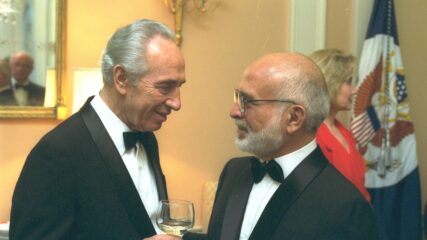
The Jordanian king and Israeli Labor Party leaders secretly outline a plan to convene an international conference to move Israeli-Palestinian talks forward through a conference format, but Likud opposition leaders squash the idea.
Jordan’s King Hussein made a strategic decision to disassociate administratively from the West Bank, leaving it to focus Jordanian national identity on only the east bank of the Jordan River. The PLO subsequently negotiated with Israel to rule over some of these lands, as codified in the 1993 Oslo Accords, but no Palestinian state was promised.
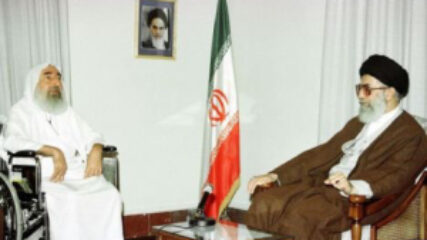
Since its inception in 1988, Hamas has been crystal clear about its total opposition to Zionism and Israel. It opposes any kind of negotiations or agreements that recognize Israel as a reality, and its more extreme spokesmen regularly incite or celebrate the killing of Jews.
As a militant Islamic Palestinian national organization, Hamas believes that Israel is illegitimate and should be destroyed through Jihad. Hamas opposes all recognition and negotiation with Israel and opposes PLO/PA leaders who have negotiated and collaborated with Israel from time to time. The Hamas-PA competition severely fragments the Palestinian political community.
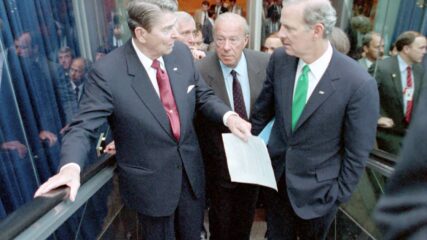
In the waning days of the Reagan administration, Secretary of State George Shultz pushes for U.S.-mediated peace negotiations, including Palestinians, and offers the outlines for a resolution to the conflict.
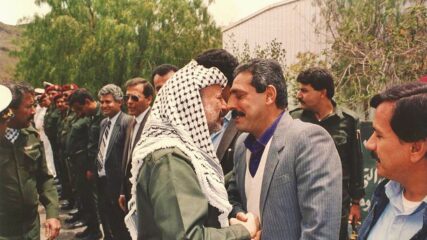
PLO Chairman Yasser Arafat issues a declaration with five American Jewish leaders in an effort to meet U.S. conditions for dialogue and thus strengthen his position as the leader of the Palestinian national movement.
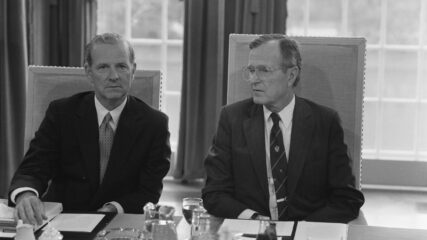
Secretary of State James A. Baker III brings a realistic and prescient vision of Arab-Israeli peace negotiations and U.S. mediation to AIPAC early in the George H.W. Bush presidency.
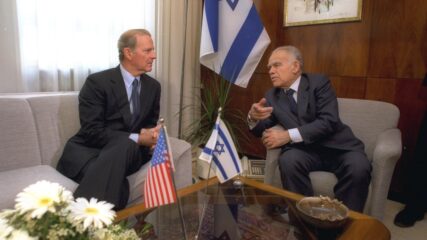
As part of the preparations for the Madrid peace conference in October 1991, U.S. Secretary of State James Baker drafts a memorandum of agreement between the U.S. and Israel regarding the particulars of resuming the Arab-Israeli peace process. He opens by reiterating that the intention of the negotiations is to achieve a regional peace agreement based on U.N. Security Council Resolutions 242 and 338.
After the 1991 Gulf War, the US orchestrates a conference with Israel, multiple Arab states, and Palestinians participating; the conference leads to bilateral and multilateral negotiations.
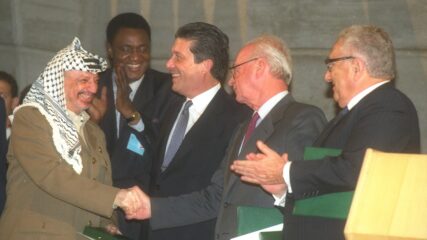
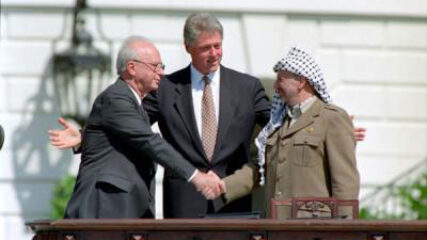
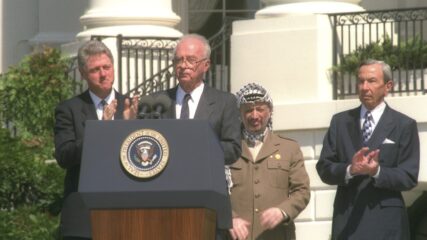
Four days before signing the Oslo Accords, the PLO and Israel recognize each other. Israel’s
Rabin worries about the growth of Hamas influence, thus elevates the PLO through international recognition.
Arafat offers gratitude to President Clinton for hosting this historic event, expressing hopes that the agreement will end a century of suffering and usher in peace coexistence and equal fights.
He acknowledges the courage of the people of Israel to seek the determination to build peace.
While advocating joint responsibility of Palestinians and Israelis to enforce the agreement, history shows that over the next decade, Arafat does not clamp down on violent attacks against Israelis.
Clinton expresses gratitude to those who brought about the possibilities of reconciling Israeli and Palestinian aspirations, and acknowledges past leaders, Menachem Begin, Anwar Sadat, Jimmy Carter, and George Bush for advancing the sides toward this moment of signing the Accords on Interim Palestinian Self-Government. Over the next two decades, funds pour into the West Bank and Gaza Strip and elections for a self governing authority are held, but autocratic rule and financial mismanagement prevail, stymying along with other reasons, successful Palestinian self-rule.
As a lifetime soldier-politician, Rabin acknowledges that the signing of the Declaration of Principles was profoundly difficult, and yet there is a yearning to end the cycle of violence and engage in reconciliation with the Palestinians. Drawing inspiration from Jewish tradition, he stresses the timeliness of pursuing peace and prays for a new era in the Middle East.
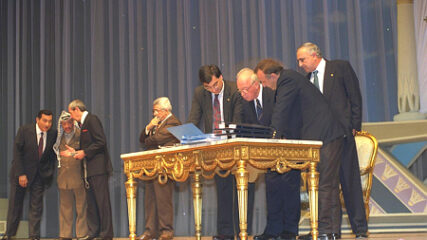
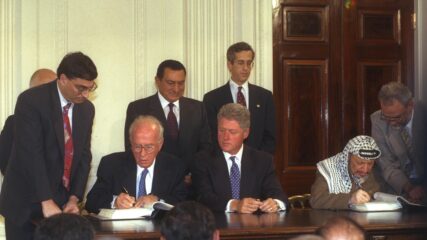
Negotiated through the Norwegians, the Oslo Accords call for limited Palestinian rule in some of the territories but do not call for a Palestinian state or an end to settlements.
An Israel State Archives document collection shows how Israel and the Palestine Liberation Organization negotiated under the Oslo Accords to achieve an agreement in May 1994 on Palestinian autonomy in Jericho and the Gaza Strip.
This was the fourth Palestinian-Israeli Agreement signed that broadly extended Palestinian self-governing arrangements throughout the West Bank and the Gaza Strip. No Palestinian state was promised, essentially only putting substance on the Palestinian autonomy agreement that Menachem Begin signed with Anwar Sadat in the 1978 Camp David Accords.
Days before his assassination, Yitzhak Rabin explains that he accepted the Oslo Accords and shook Yasser Arafat’s hand because the PLO represented the last hope for a secular Palestinian nationalism amid the rise of Hamas.
After failing to have PLO leader Yasser Arafat and Israeli Prime Minister Ehud Barak reach an understanding at Camp David in mid-2000, President Bill Clinton offers a U.S. view of a final-status agreement near the end of his term.
In the midst of severe Palestinian-Israeli clashes, a committee led by former U.S. Sen. George Mitchell concludes, as had many previous investigations, that the two communities fear and want to live separately from each other. From the report flows the EU-U.N.-U.S. commitment to a two-state solution suggested in the 2003 Roadmap for Peace.
CIA Director George Tenet proposes a cease-fire to stop vicious Palestinian-Israeli violence that carries on for four more years. The plan seeks to restore Palestinian-Israeli security cooperation, end incitement, arrest militants and establish mechanisms for accountability through the U.S.
This is the first U.N. resolution to call for “two States, Israel and Palestine, to live side by side within secure and recognized borders.”