Eisenhower Doctrine, 1957CIE+
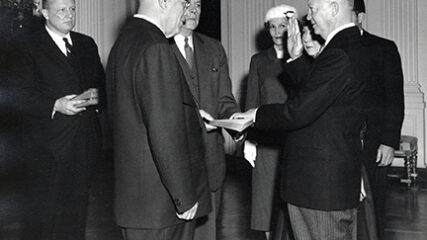
Further reinforcing the Truman Doctrine, the US President promises military or economic aid to any Middle Eastern country resisting Communist aggression.
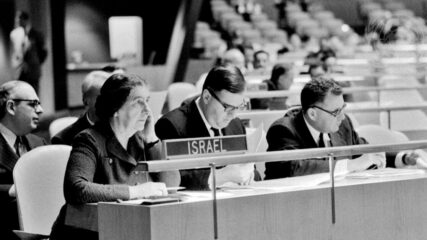
Golda Meir tells the U.N. General Assembly that Israel will comply with demands that it withdraw to the 1949 armistice lines with Egypt, but it expects U.N. support to keep the Straits of Tiran open.
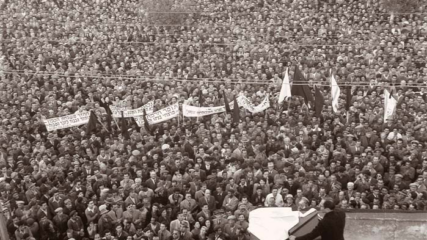
Ten days before the start of the Six-Day War, Egyptian President Gamal Abdel Nasser declares that Egypt, Syria and other Arab states intend to destroy Israel.
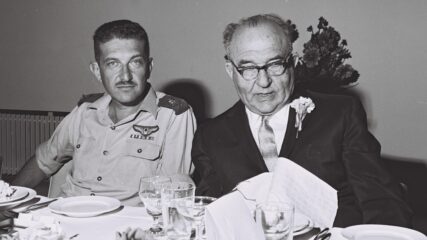
With tensions on its borders, Eshkol tries to reassure Israeli public. Instead he gives a “painfully faltering” speech. Popular and party disgruntlement follow, opening the way for Eshkol to turn over the Defense Ministry two days later to General Moshe Dayan.
Egyptian President Gamal Abdel Nasser asserts that the conflict with Israel is not over access to the Gulf of Aqaba but the very existence of Israel; Egypt’s foes are Britain and the United States, which support Israel.
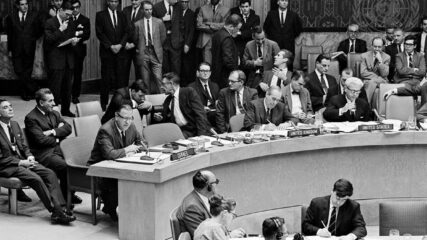
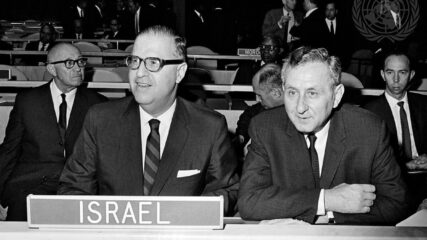
The Israeli ambassador to the United Nations delivers a detailed outline of events that will lead to war two days later.
The Israel State Archives’ “The Six Day War Files” includes Cabinet and Security Cabinet meeting transcripts that were classified for 50 years.
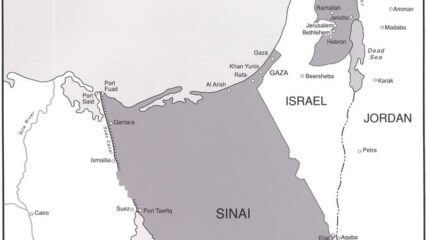
After the Israeli army swept through Sinai in four days, the Egyptian president acknowledges the success of Israel’s pre-emptive strike but blames the U.S. and Britain. Still, he takes responsibility for the Arab defeat and resigns.
Two days after the conclusion of the June 1967 War, Eshkol, recounts the series of events that led to war, the war itself and the immediate aftermath. He reaches out to Arab states for peace seeking a path to peace with her belligerent neighbors. A week later, Israel will quietly messages Cairo and Damascus through the US, hat Israel seeks an end to the conflict. No answers are received.
President Johnson’s remarks became the philosophical outline for UN Resolution 242 passed in November 1967. Core to his view was that Israel would not need to return to the pre-1967 war borders, and that the territorial integrity and sovereignty of all states in the region should be protected.
Following the conclusion of the June 1967 War, the Israeli government sent word to Egypt and Syria seeking peace plan that was intended to jumpstart a peace process with Israel’s belligerent neighbors, Egypt and Syria. The messages were sent through the US, but no response was apparently received.
After the June 1967 war, the Israeli government sent word through the United States to Egypt and Syria seeking to jump-start a peace process. Apparently no response was received.
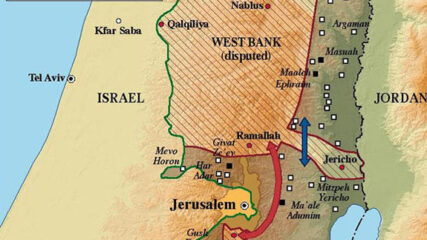
Yigal Allon’s plan for handling the areas captured from Jordan during the just-completed Six-Day War reflects Israel’s previous border vulnerability and seeks a West Bank arrangement that is not a strategic or geographic threat.
Arab states declare “no peace, no negotiation, no recognition” with Israel after their collective defeat in the June 1967 War.
Resolution 242 calls for Israeli withdrawal from unspecified captured territories in return for the right of all states to live in peace. It does not call for a full withdrawal. It is the basis for treaties with Egypt (1979) and Jordan (1994) and for PLO recognition of Israel (1993).
Without any consultation with Jerusalem, Israel rejects US proposal for full withdrawal.
This volume of the U.S. government’s “Foreign Relations of the United States” series provides foreign policy documents on the Arab-Israeli conflict before, during and after the October 1973 war.
October 6, 2023, was the 50th anniversary of the outbreak of the October 1973 war. Six months prior, Egyptian President Sadat sent his national security adviser to meet with Secretary of State Kissinger to determine whether the U.S. would engage Egypt and Israel in serious mediation for a Sinai agreement, or a series of them, all focused on Israeli withdrawal and gradual acceptance of Israel. Kissinger did not take Sadat’s overtures seriously. Would American action then have avoided the October 1973 war? All informed analyses say no.
In carrying out research in the 1990s for Heroic Diplomacy: Sadat, Kissinger, Carter, Begin and the Quest for Arab-Israeli Peace, Routledge, 1999, I undertook 84 interviews with individuals who participated in the diplomacy.
The October 1973 war broke the logjam over whether diplomacy could unfold to kick off Arab-Israeli negotiations. Sadat used the 1973 war as an engine to harness American horsepower. In that he succeeded because U.S. Secretary of State Kissinger saw Sadat’s leaning to Washington not only as a chance to begin useful negotiations, but also of great significance to weaning the Egyptian president away from Moscow.
U.S. Secretary of State Kissinger failed to persuade Syrian President Assad to attend the December 1973 Geneva Middle East Peace Conference. Assad saw the proposed conference, which it was, a ruse to cover up a “pre-cooked” Israeli-Egyptian arrangement. Assad wanted no part of implicitly supporting any agreement where Israel’s legitimacy might be enhanced.
The U.S. mediates an agreement separating forces in Sinai after the October 1973 war. Egyptian and Israeli generals will negotiate additional details.
The US promises to implement an Egyptian-Israeli disengagement agreement and have the Suez Canal cleared. Israel sees eventual repopulation of Suez Canal cities as a sign that Egypt will not go to war again soon.
On the Golan Heights, Israel agrees to a limited withdrawal, and the United Nations places forces between the Syrian and Israeli armies. With few exceptions this border remains quiet for more than 40 years.