Explainer: What Is Zionism?
From biblical times to the present, Jews and Judaism have had an unbroken connection to Zion, a reference to Eretz Yisrael, the Land of Israel, derived from the hill at the heart of Jerusalem. Zionism…
By Scott Abramson, May 2024 Introduction — A Unique Hatred If the Bible nearly 3,000 years ago described the Jews as “a people who shall dwell alone,” Jewish history has since validated this as prophecy….
Glossaries This section offers easy access to names, events, and terms associated with modern Israeli history. Terms listed were used successfully by students for understanding context in learning about modern Israel and the Middle East….
America’s need for a robust higher education system, where students learn to think deeply, engage respectfully, and disagree constructively, is greater than ever.
Sung or recited on Passover, the original Dayenu is reflective appreciation of 14 significant events specifically wrapped around the exodus from Egypt. The Dayenu presented here chronicles Jewish history from Exodus to the present day. This history can be read individually or responsively. Different moments and personalities in Jewish history could have been included. Hebrew and Spanish versions of Dayenu are available.
From the biblical covenants, Jews bound themselves to the belief in one G-d, an unbreakable tie to the Land of Israel. From its inception, Jewish identity was wrapped around the mutual commitments between G-d and the people. Judaism became the foundation for Christianity and Islam.
From 1898 to 1948, Zionism evolved from an idea to a concrete reality: the actual establishment of the Jewish state, Israel. Slowly, a few immigrating Jews created facts by linking people to the land. For half a century, fortuity and fortitude made the Zionist undertaking a reality. They exhibited pragmatism and gradually constructed a nucleus for a state. Through perseverance Zionists empowered themselves.
Neither Israel’s political culture nor Israel’s democracy based on Jewish self determination simply materialized on May 15, 1948. A connection exists from Jewish self-rule in the Diaspora to Zionist political autonomy during the Yishuv and to contemporary Israeli political culture. Likewise, the origins of Israeli democracy are found in the hundreds of years of Jewish Diasporas transitioning into the Zionist movement to the state; from aliyot before the Palestine Mandate to 1948 and since. Components of Israeli political culture…
להיות עם חופשי בארצנו Zionism’s two part history, Early History to 1897 and Zionism 1898 to 1948 Where has Zionism succeeded? What remains incomplete or unfinished? Finished or well-shaped results of Zionism Unfinished results…
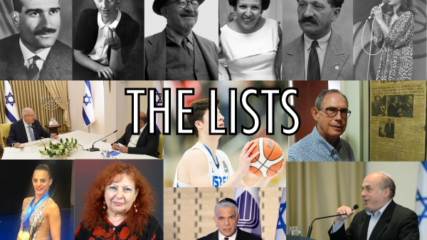
To commemorate the State of Israel’s forthcoming 75th birthday, the Center for Israel Education is sharing lists of 75 people and things that form a mosaic of Israel’s past, present and future.
Explore the foundational text of the State of Israel.
While the Zionist-Arab/Israeli-Palestinian conflict is never absent from the calendar, April is a month that has brought advances toward Israel being a normal part of the global community through educational institutions, cultural achievements, sports victories, diplomatic gains and technological contributions.
March has seen some of the worst moments in Zionist history. The first Arab-Jewish battle at Tel Hai in 1920 killed Joseph Trumpeldor. The War of Attrition forced Israel to pay a continual toll for its success in the 1967 war. Terrorist attacks on Tel Aviv’s Savoy Hotel in 1975 and along the Coastal Road in 1978 traumatized the nation. Six Arab citizens were killed in 1976 when land protests turned violent.
“We are very grateful for the learning and the PD that the program provides our faculty and look forward to continuing this in the next school year 2022-23.” Sinai Akiba, Los Angeles, CA “For years…
Adopting a systematic, yet non-technical, approach, Jacob Metzer’s book is the first to analyze the divided economy of Mandatory Palestine from the viewpoints of modern economic history and development economics.
Compiled by the Center for Israel Education, January 2023 February has historically been a month when the Zionist dream of a Jewish homeland and its defense confronted realities of world politics and diplomacy, from a…
Compiled by the Center for Israel Education, January 2023 January in Zionist history has been a month for frustrated peace efforts and life transitions. Jan. 2, 1927 — Death of Ahad Ha’am Ahad Ha’am, the…
Examination of the mobilization of society for the Israeli War of Independence effort enables one to present a more extended process that began in October 1947 — some two months prior to the outbreak of the war — and ended, from the standpoint of mobilization of personnel, at the beginning of 1949, when demobilization of the first draftees from the wartime army took place, and from an economic standpoint in April 1949, when an Austerity system was declared in the State of Israel.
Compiled by the Center for Israel Education, 2022 If November historically has been a month for some of Zionism’s highest highs (the Balfour Declaration, Anwar Sadat’s visit to Jerusalem, U.N. Resolution 181) and its lowest…
Michael Jacobs, November 4, 2022 From the founding of Petah Tikvah, through the Balfour Declaration and the U.N. partition resolution to Anwar Sadat’s address to the Knesset and the assassination of Yitzhak Rabin, November has…
Dr. Tal Grinfas-David, March 1, 2022 When it comes to boosting Israel education, some schools go through transactional changes, and some go through transformative changes. What’s the difference? Transactional schools add units and information, making…
Steven Bayme In early November 2021, The New York Times Magazine posted an essay under the provocative title “Inside the Unraveling of American Zionism.”1 The essay focused on a letter signed by 93 rabbinical and…
Wendy Kalman, November 30, 2021 As a researcher at the Center for Israel Education, I review and correct interview transcripts. CIE founder and Chief Content Officer Ken Stein interviewed nearly 90 diplomats, politicians and others…
Since the 1920s the Sacred Esplanade of Jerusalem came to symbolise the bone of contention in the conflict over Palestine. The maintenance and even definition of the lines of division between the communities was a clear aim of the British authorities from 1920-1948. The communal/religious conflicts intensified after 1967 with the Israeli capture of East Jerusalem and other Arab-populated territory, which left neither side fully content.