<span class="cie-plus-title">U.S.-Israel Memorandum of Agreement on the Peace Process, September 1991</span><span class="cie-plus-badge">CIE+</span>

U.S.-Israel Memorandum of Agreement on the Peace Process, September 1991CIE+

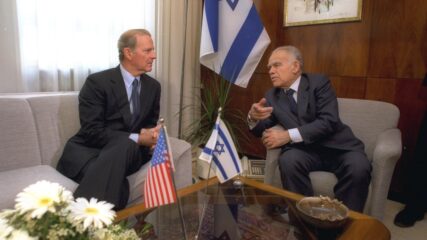
As part of the preparations for the Madrid peace conference in October 1991, U.S. Secretary of State James Baker drafts a memorandum of agreement between the U.S. and Israel regarding the particulars of resuming the Arab-Israeli peace process. He opens by reiterating that the intention of the negotiations is to achieve a regional peace agreement based on U.N. Security Council Resolutions 242 and 338.

Documents and Sources|September 16, 1991
<span class="cie-plus-title">Remarks by President Clinton at Signing of Oslo Accords, 1993</span><span class="cie-plus-badge">CIE+</span>

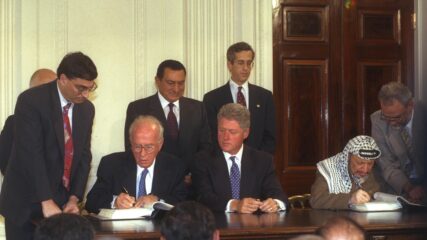
Remarks by President Clinton at Signing of Oslo Accords, 1993CIE+

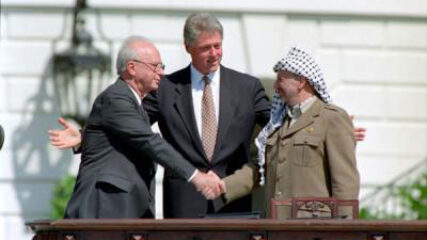
Clinton expresses gratitude to those who brought about the possibilities of reconciling Israeli and Palestinian aspirations, and acknowledges past leaders, Menachem Begin, Anwar Sadat, Jimmy Carter, and George Bush for advancing the sides toward this moment of signing the Accords on Interim Palestinian Self-Government. Over the next two decades, funds pour into the West Bank and Gaza Strip and elections for a self governing authority are held, but autocratic rule and financial mismanagement prevail, stymying along with other reasons, successful Palestinian self-rule.

Documents and Sources|September 13, 1993
<span class="cie-plus-title">Israeli-Jordanian Treaty Excerpts, 1994</span><span class="cie-plus-badge">CIE+</span>

Israeli-Jordanian Treaty Excerpts, 1994CIE+

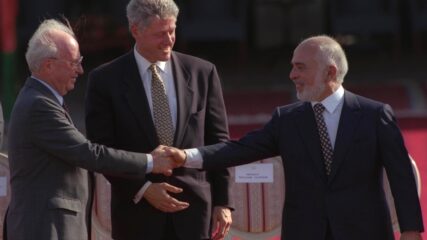
Jordan becomes the second Arab country after Egypt (1979) to sign a peace treaty ending the state of war with Israel. The Treaty addresses boundary demarcations, water sharing, police and security cooperation, environmental issues, border crossings, administration of Muslim holy sites and other issues.

Documents and Sources|October 26, 1994
<span class="cie-plus-title">Presidents Clinton and Assad Meet in Damascus, 1994</span><span class="cie-plus-badge">CIE+</span>

Presidents Clinton and Assad Meet in Damascus, 1994CIE+

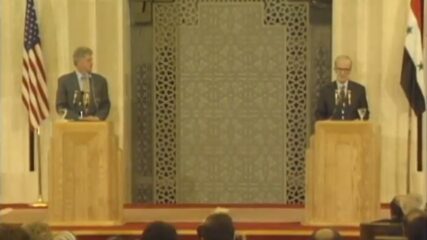
A day after the signing of the Jordan-Israel peace treaty and hours before addressing the Knesset, U.S. President Bill Clinton meets with his Syrian counterpart, Hafez al-Assad, in Damascus and expresses optimism that Syria will be part of a comprehensive Middle East peace. Assad continues to insist on the full return of the Golan Heights.

Documents and Sources|October 27, 1994
<span class="cie-plus-title">Mitchell Report, 2001</span><span class="cie-plus-badge">CIE+</span>

Mitchell Report, 2001CIE+

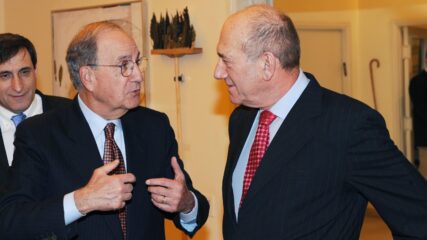
In the midst of severe Palestinian-Israeli clashes, a committee led by former U.S. Sen. George Mitchell concludes, as had many previous investigations, that the two communities fear and want to live separately from each other. From the report flows the EU-U.N.-U.S. commitment to a two-state solution suggested in the 2003 Roadmap for Peace.

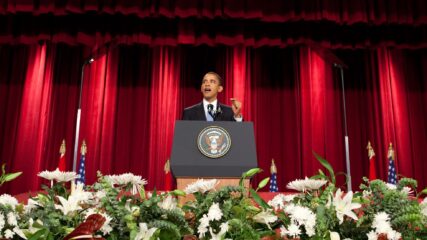
<span class="cie-plus-title">President Barack Obama’s Speech at Cairo University, 2009</span><span class="cie-plus-badge">CIE+</span>

President Barack Obama’s Speech at Cairo University, 2009CIE+

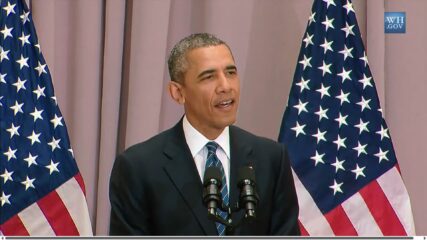
Barack Obama, while seeking to improve America’s image by urging an end to violence and stereotypes, emphasizes the need for a two-state Israeli-Palestinian solution as part of a reset of U.S. relations with the Muslim world. His advocacy of soft power distinguishes his administration from George W. Bush’s use of force. Nine years later, Donald Trump’s secretary of state, also in Cairo, heavily criticizes the Obama soft-power approach.

<span class="cie-plus-title">Joint Comprehensive Plan of Action (JCPOA) — Containing Iran’s Access to Nuclear Weapons, 2015</span><span class="cie-plus-badge">CIE+</span>

Joint Comprehensive Plan of Action (JCPOA) — Containing Iran’s Access to Nuclear Weapons, 2015CIE+

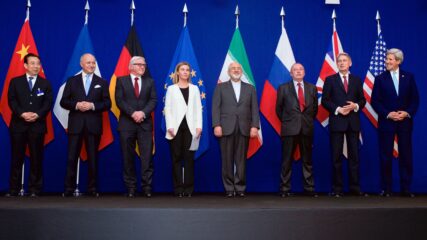
Under the deal between Iran and five world powers, Iran agreed to dismantle much of its nuclear program in exchange for billions of dollars of sanctions relief. Israel called the deal too lenient. On May 8, 2018, President Trump withdrew the U.S. from the JCPOA, calling it one of the “worst and most one-sided” agreements in U.S. history. Israel’s objectives in attacking Iran in June 2025 focused on the same central features Israel argued a decade earlier were not sufficiently addressed in the JCPOA.