Eisenhower Doctrine, 1957CIE+
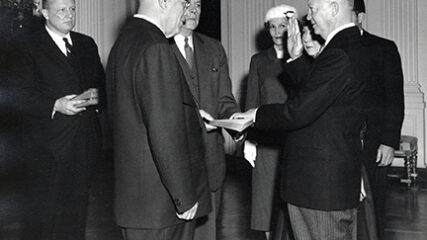
Further reinforcing the Truman Doctrine, the US President promises military or economic aid to any Middle Eastern country resisting Communist aggression.
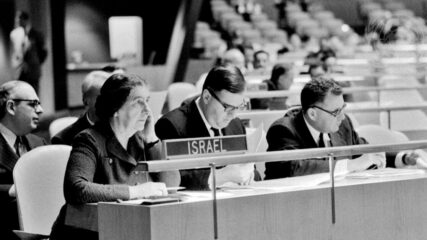
Golda Meir tells the U.N. General Assembly that Israel will comply with demands that it withdraw to the 1949 armistice lines with Egypt, but it expects U.N. support to keep the Straits of Tiran open.
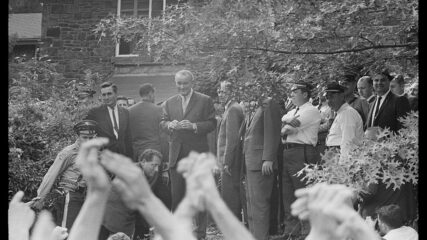
President Johnson’s remarks became the philosophical outline for UN Resolution 242 passed in November 1967. Core to his view was that Israel would not need to return to the pre-1967 war borders, and that the territorial integrity and sovereignty of all states in the region should be protected.
Resolution 242 calls for Israeli withdrawal from unspecified captured territories in return for the right of all states to live in peace. It does not call for a full withdrawal. It is the basis for treaties with Egypt (1979) and Jordan (1994) and for PLO recognition of Israel (1993).
Without any consultation with Jerusalem, Israel rejects US proposal for full withdrawal.
In carrying out research in the 1990s for Heroic Diplomacy: Sadat, Kissinger, Carter, Begin and the Quest for Arab-Israeli Peace, Routledge, 1999, I undertook 84 interviews with individuals who participated in the diplomacy.
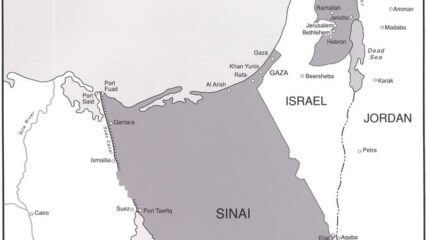
The U.S. mediates an agreement separating forces in Sinai after the October 1973 war. Egyptian and Israeli generals will negotiate additional details.
The US promises to implement an Egyptian-Israeli disengagement agreement and have the Suez Canal cleared. Israel sees eventual repopulation of Suez Canal cities as a sign that Egypt will not go to war again soon.
Cairo and Jerusalem agree to additional Sinai withdrawals, demilitarized zones, limited force zones and, importantly, placement of US civilians in Sinai to monitor observance of agreement.
The US promises coordination with Israel on resumed negotiations, not to negotiate or recognize
the PLO until it recognizes Israel’s right to exist, and accepts UNSC Resolutions 242 (1967) and 338 (1973).
For the first time a US State Department official states the “legitimate interests of the Palestinian Arabs must be taken into account in the negotiating of an Arab-Israeli peace.”
Outlining an Arab-Israeli settlement, the Brookings report calls for Israel to withdraw to “almost the pre-June War borders” and for “extensive Palestinian autonomy.” The Carter administration embraces the report for its foreign policy.
With candor, Israeli Foreign Minister Allon tells Secretary of State Vance that the Israeli Labor government would under no circumstances negotiate with the PLO until it gave up terrorism, recognized UNSC 242, and unequivocally accepted Israel’s right to exist. Only in 1993, did the PLO accept these premises, Sixteen years had then passed while Israel built settlements virtually without restraint in the territories.
Carefully stated, Carter says that there should be a homeland for the Palestinian refugees. He is the first US president to assert the need for a place for the Palestinians and for Israel’s right to exist in peace.
When the Carter Administration entered office in 1977, an early foreign policy priority was to kick-start Middle East negotiations. In this Policy Review Committee Meeting, Carter’s staff proposed a negotiating outcome that would pass through a conference, including the withdrawal of Israel’s forces to almost the 1967 borders, bringing the PLO into talks as Palestinian representatives, all the while seeking to uphold Israel’s security requirements.
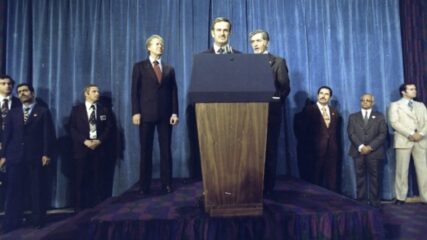
This meeting was the only one between U.S. President Carter and Syrian President Assad during the Carter administration. Carter wanted to learn Assad’s requirements for an agreement with Israel. Assad doubted that the Saudis would join this process. In the end, Assad made it clear that he was not rushing into an agreement with Israel, even if asked by the United States. Carter acknowledged knowing little about the Palestinian refugee issue and said the U.S. was committed to the security of Israel.
Begin tells Carter that Judea, Samaria (the West Bank) and the Gaza Strip will not be placed under foreign sovereignty; likewise, these areas will not be annexed, leaving them open for possible negotiations.
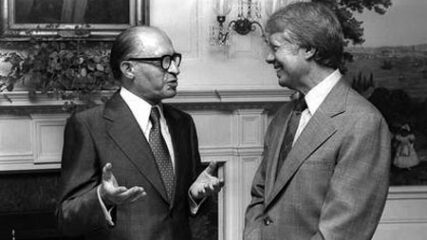
After his surprise electoral victory in May, Prime Minister Menachem Begin traveled to Washington to establish a rapport with President Carter. While this initial meeting was cordial, each met the other’s stubbornness, a characteristic that would keep their relationship respectful but acrid for years to come.
The vast gulf in US and Israeli positions about Palestinian self-determination, the degree of withdrawal from the West Bank, and future borders is precisely stated. A year later at the end of the Camp David negotiations, Israeli and US views had not changed at all.
In two meetings at the White House, the Syrian foreign minister insists on the PLO’s presence at a regional peace conference and wins U.S. support for some kind of Palestinian “entity.”
Naively, the Carter Administration believes that a conference with the USSR would start comprehensive negotiations; instead, the fear of Moscow’s engagement helps drive direct Egyptian-Israeli talks.
After brutally frank and caustic meetings between Israeli Foreign Minister Dayan and President Carter, the US relents to Israeli demands that a peace conference be only an opening for direct talks.
Five weeks after Egyptian President Anwar Sadat flew to Jerusalem in November 1977, to accelerate Egyptian – Israeli negotiations, Begin brought to President Jimmy Carter, Israel’s response to Sadat’s peace initiative: political autonomy for the Palestinians in the West Bank and Gaza Strip. No Palestinian state was considered.
Having made human rights a central pillar of his foreign policy, Carter nonetheless seemingly ignored the abuses the Shah of Iran imposed upon his own people. Carter’s unctuous praise for the Shah at this state dinner angered Iranians in general, the clerical regime that replaced the Shah in 1979, resulting in negative consequences for Carter as he went into the 1980 presidential election.