Israel-Lebanon Agreement, Ratified by Israel but not Lebanon, 1983CIE+
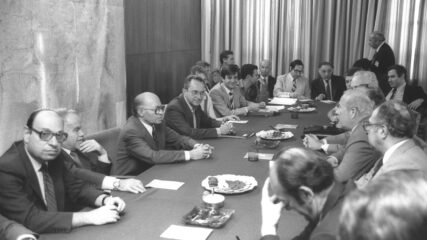
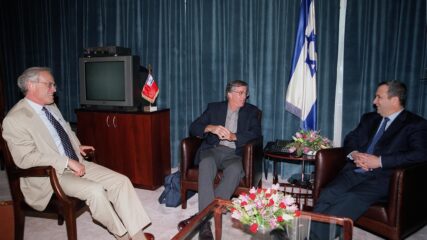
Israel and Lebanon agreed to a treaty in 1983 through U.S. mediation, only for Syria’s dominance and Lebanon’s dysfunction to block ratification.
Areas of bilateral political and military cooperation are noted to fend off Soviet involvement in the Middle East, to assist Israel in building the Lavi aircraft, to support an independent Lebanon and to promote Arab-Israeli negotiations.
Jimmy Carter, “The U.S.-Iran Relationship, the Shah’s Downfall, Khomeyni’s Rise to Power, and the Hostage Crisis,” an Emory class presentation, Atlanta, March 24, 1985, recorded and transcribed with permission.
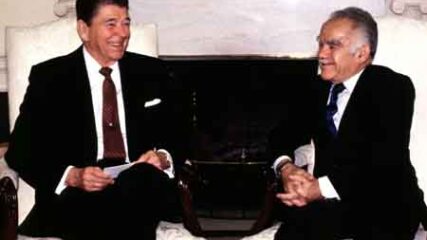
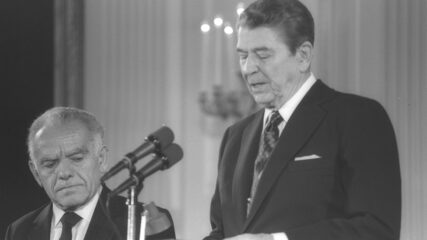
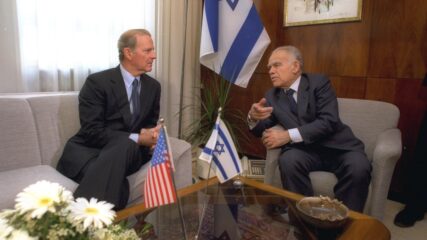
The agreement affirms the close relationship between the U.S. and Israel based on common goals, celebrates the 3-year-old U.S.-Israel Free Trade Agreement, and institutes multiple regular meetings between Israeli and U.S. officials.
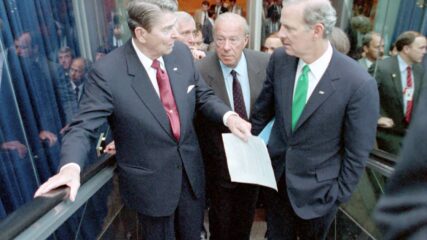
In the waning days of the Reagan administration, Secretary of State George Shultz pushes for U.S.-mediated peace negotiations, including Palestinians, and offers the outlines for a resolution to the conflict.
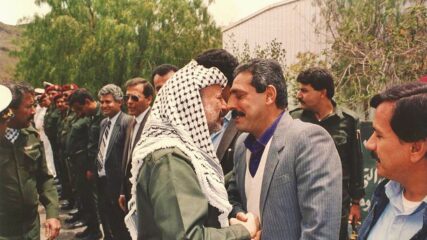
PLO Chairman Yasser Arafat issues a declaration with five American Jewish leaders in an effort to meet U.S. conditions for dialogue and thus strengthen his position as the leader of the Palestinian national movement.
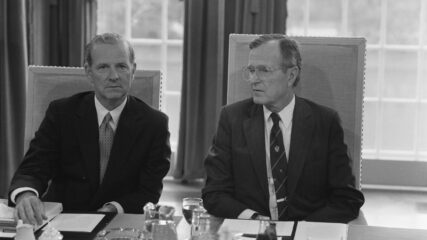
Secretary of State James A. Baker III brings a realistic and prescient vision of Arab-Israeli peace negotiations and U.S. mediation to AIPAC early in the George H.W. Bush presidency.
U.S. Secretary of State James Baker warns that the United States will not accept Saddam Hussein’s erasure of Kuwait a month earlier. Baker says intimidation and force will not be tolerated in the post-Cold War world.
As part of the preparations for the Madrid peace conference in October 1991, U.S. Secretary of State James Baker drafts a memorandum of agreement between the U.S. and Israel regarding the particulars of resuming the Arab-Israeli peace process. He opens by reiterating that the intention of the negotiations is to achieve a regional peace agreement based on U.N. Security Council Resolutions 242 and 338.
After the 1991 Gulf War, the US orchestrates a conference with Israel, multiple Arab states, and Palestinians participating; the conference leads to bilateral and multilateral negotiations.
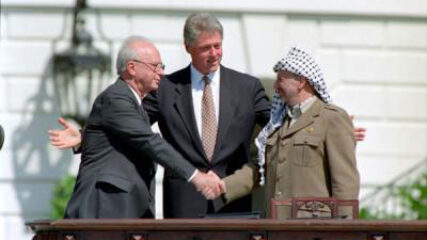
Clinton expresses gratitude to those who brought about the possibilities of reconciling Israeli and Palestinian aspirations, and acknowledges past leaders, Menachem Begin, Anwar Sadat, Jimmy Carter, and George Bush for advancing the sides toward this moment of signing the Accords on Interim Palestinian Self-Government. Over the next two decades, funds pour into the West Bank and Gaza Strip and elections for a self governing authority are held, but autocratic rule and financial mismanagement prevail, stymying along with other reasons, successful Palestinian self-rule.
Negotiated through the Norwegians, the Oslo Accords call for limited Palestinian rule in some of the territories but do not call for a Palestinian state or an end to settlements.
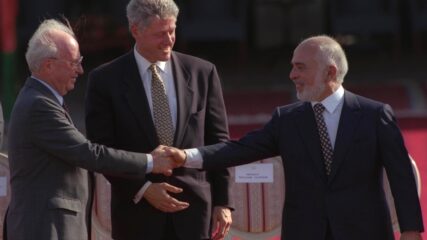
Jordan becomes the second Arab country after Egypt (1979) to sign a peace treaty ending the state of war with Israel. The Treaty addresses boundary demarcations, water sharing, police and security cooperation, environmental issues, border crossings, administration of Muslim holy sites and other issues.
A day after the signing of the Jordan-Israel peace treaty and hours before addressing the Knesset, U.S. President Bill Clinton meets with his Syrian counterpart, Hafez al-Assad, in Damascus and expresses optimism that Syria will be part of a comprehensive Middle East peace. Assad continues to insist on the full return of the Golan Heights.
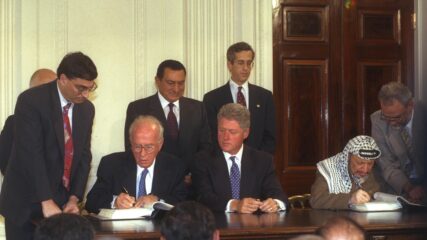
This was the fourth Palestinian-Israeli Agreement signed that broadly extended Palestinian self-governing arrangements throughout the West Bank and the Gaza Strip. No Palestinian state was promised, essentially only putting substance on the Palestinian autonomy agreement that Menachem Begin signed with Anwar Sadat in the 1978 Camp David Accords.
After failing to have PLO leader Yasser Arafat and Israeli Prime Minister Ehud Barak reach an understanding at Camp David in mid-2000, President Bill Clinton offers a U.S. view of a final-status agreement near the end of his term.
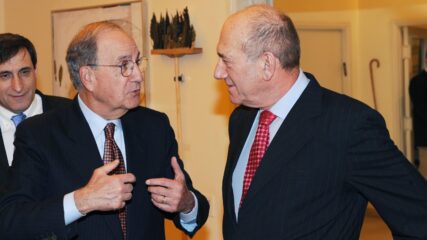
In the midst of severe Palestinian-Israeli clashes, a committee led by former U.S. Sen. George Mitchell concludes, as had many previous investigations, that the two communities fear and want to live separately from each other. From the report flows the EU-U.N.-U.S. commitment to a two-state solution suggested in the 2003 Roadmap for Peace.
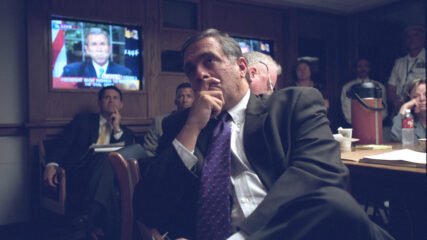
CIA Director George Tenet proposes a cease-fire to stop vicious Palestinian-Israeli violence that carries on for four more years. The plan seeks to restore Palestinian-Israeli security cooperation, end incitement, arrest militants and establish mechanisms for accountability through the U.S.
President Bush castigates PLO leader Arafat for support of terrorism and condemns Palestinian groups that “seek Israel’s destruction.” He also suggests that Israel economically support a viable Palestinian state.
As a negotiating plan it seeks an end to the conflict with reciprocal performance objectives. Israel accepts the plan with some reservations; Hamas rejects it out of hand. The plan is not enacted.
Israeli Prime Minister Olmert and Palestinian leader Abbas meet near Washington to kick-start negotiations by implementing previous promises; the U.S. is to judge performance to see if a treaty can result. It does not.
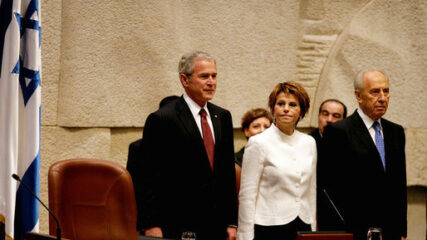
Delivering the third address by a U.S. president to the Knesset, George W. Bush celebrates Israel’s 60th birthday by emphasizing the enduring U.S.-Israel relationship based on shared values.
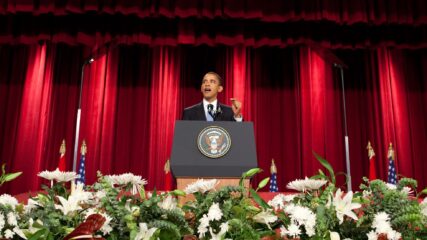
Barack Obama, while seeking to improve America’s image by urging an end to violence and stereotypes, emphasizes the need for a two-state Israeli-Palestinian solution as part of a reset of U.S. relations with the Muslim world. His advocacy of soft power distinguishes his administration from George W. Bush’s use of force. Nine years later, Donald Trump’s secretary of state, also in Cairo, heavily criticizes the Obama soft-power approach.
Focusing on the Arab Spring and Palestinian-Israeli negotiations, President Obama seeks democratic reform in the region and advocates two states for two peoples based on the 1967 lines with land swaps.