Prime Minister Begin’s Report on Treaties With Arab States and His Visit to Romania, 1977

Prime Minister Begin’s Report on Treaties With Arab States and His Visit to Romania, 1977 CIE+ members only

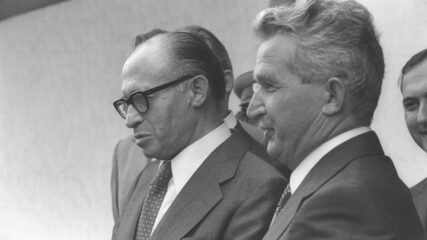
Unknown to the Carter administration and one month before it issued the US-Soviet Declaration to convene an international Middle East Peace Conference, Prime Minister Begin tells the cabinet that he learned from the Rumanian president that Sadat wishes to have Israeli and Egyptian representatives meet in secret talks. That bi-lateral Dayan -Tuhami meeting takes place on September 16. Begin refers to advanced drafts of proposed treaties between Israel and each Arab state; he presents details about Rumanian Jewish immigration to Israel.

Documents and Sources|September 4, 1977
Memorandum of Conversation Between U.S. President Carter and Israeli Foreign Minister Dayan, October 1977

Memorandum of Conversation Between U.S. President Carter and Israeli Foreign Minister Dayan, October 1977 CIE+ members only

Common to both the Labor Party and to Begin’s government was a fear that the US would pressure Israel into unwanted concessions and deny Israel its right to sovereign decision-making. It was a concern that Dayan expressed in this October 1977 meeting, and one that he would articulate on several occasions during the Camp David negotiations.

Documents and Sources|October 4, 1977
Memorandum of Conversation Between U.S. President Carter and Israeli Prime Minister Begin and Their Delegations, March 1978

Memorandum of Conversation Between U.S. President Carter and Israeli Prime Minister Begin and Their Delegations, March 1978 CIE+ members only

After a year in office, the Carter administration’s initiative to achieve a comprehensive Middle East peace between Israel and her Arab neighbors had stalled. At this White House meeting, Dayan reviewed Israel’s concerns about the West Bank and Brzezinski criticized Begin’s autonomy plan for the Palestinians. Begin and Carter’s mutual dislike over policy decisions continued to rise.

Documents and Sources|March 21, 1978
Memorandum of Conversation of Israeli Foreign Minister Moshe Dayan and Defense Minister Ezer Weizman With U.S. Secretary of State Cyrus Vance and Secretary of Defense Harold Brown at Camp David, September 7, 1978

Memorandum of Conversation of Israeli Foreign Minister Moshe Dayan and Defense Minister Ezer Weizman With U.S. Secretary of State Cyrus Vance and Secretary of Defense Harold Brown at Camp David, September 7, 1978 CIE+ members only

Early during the Camp David summit, Moshe Dayan, Ezer Weizman and other Israeli officials address resettlement and payment of 1967 and 1948 Palestinian refugees and Israeli military redeployment on the eastern and western borders, while Zbigniew Brzezinski, Cyrus Vance and other Americans emphasize Palestinian sovereignty.

Documents and Sources|September 7, 1978
Memorandum of Conversation Between U.S. and Egyptian Delegations at Camp David, September 11, 1978

Memorandum of Conversation Between U.S. and Egyptian Delegations at Camp David, September 11, 1978

President Sadat evolved and presented the bulk of Egypt’s views at Camp David, greatly limiting his advisers’ participation. He particularly kept them from demanding Palestinian rights from Israel, which would have ended the talks without an agreement. Sadat anointed President Carter as the more willing, tougher negotiator with the Israelis. Sadat left Camp David with the U.S. at deep odds with the Israelis and Egypt as close as ever to Carter and the Americans.

Documents and Sources|September 11, 1978
Secretary of State Cyrus Vance Meets With Israeli Delegation at Camp David, September 14, 1978

Secretary of State Cyrus Vance Meets With Israeli Delegation at Camp David, September 14, 1978 CIE+ members only

This meeting between Secretary of State Cyrus Vance and the Israeli delegation exemplified the injection of US interests and the application of concerted diplomatic pressure on Israel. The Israeli delegation at Camp David repeatedly refused the Carter administration’s vigorous efforts to introduce new formulations that might ultimately result in a Palestinian state.

Documents and Sources|September 14, 1978
Memorandum of Conversation Among President Carter, Secretary of State Vance, Prime Minister Begin and Foreign Minister Dayan at Camp David, September 16, 1978

Memorandum of Conversation Among President Carter, Secretary of State Vance, Prime Minister Begin and Foreign Minister Dayan at Camp David, September 16, 1978 CIE+ members only

In this meeting, the contents of which have not been released by the Foreign Relations of the United States (FRUS) but are available from the Israel State Archives (ISA), Begin clearly committed that “perhaps one military settlement” in the Jordan Valley would be established during the three months of the treaty negotiations. The extraordinarily contentious public dispute on the settlements would mar the diplomatic success of the Camp David Accords and add tension to the already fraught Carter-Begin relationship.

Documents and Sources|September 16, 1978
U.S., Israeli Negotiators at Camp David Discuss Resolution 242, September 16, 1978

U.S., Israeli Negotiators at Camp David Discuss Resolution 242, September 16, 1978 CIE+ members only

U.S. and Israeli officials at Camp David spend a session focused on the land-for-peace U.N. Security Council Resolution 242 and how it applies to the West Bank, Jordan, Israel and the Palestinians. Appropriate for a discussion over 242, whose application depends on the absence of the word “the,” the officials argue over using boundary, border, line, borderline or something else.

Documents and Sources|September 16, 1978
Camp David Accords, 1978

Camp David Accords, 1978

With President Carter mediating, Sadat and Begin agree to two outlines: a framework for a treaty between them and to define Palestinian “autonomy,” not self-determination or a state for them.

Documents and Sources|September 17, 1978
Camp David Conversation Between President Carter and Foreign Minister Dayan on Jerusalem, September 17, 1978

Camp David Conversation Between President Carter and Foreign Minister Dayan on Jerusalem, September 17, 1978 CIE+ members only

On the last day of negotiations at Camp David, President Carter asked Israel to accept the US position that Jerusalem was occupied territory; Dayan shot back in vigorous opposition, “if we had known that you would declare your position on Jerusalem, we would not have come here. This is the first time that we are confronted with an American position and specifically on the most sensitive issue. All your positions with regards to settlements are insignificant compared to our confrontation on the issue of Jerusalem.”

Documents and Sources|September 17, 1978