Israeli-Egyptian General Armistice Agreement Excerpts, 1949CIE+
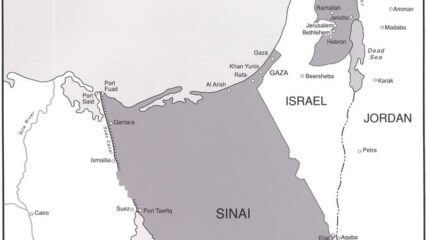
One of four agreements Israel signed in 1949 with Arab neighbors, it does not end the state of war between Israel and Egypt. They do not sign a treaty until 1979.

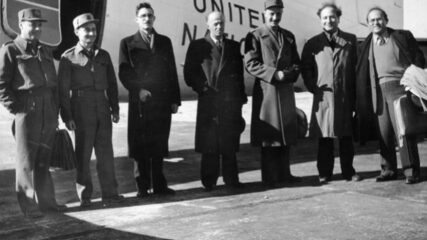
One of four agreements Israel signed in 1949 with Arab neighbors, it does not end the state of war between Israel and Egypt. They do not sign a treaty until 1979.
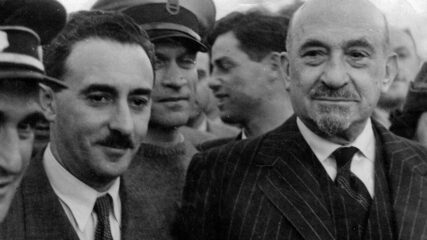
Sharett gives an overview of Israeli foreign policy, key issues, and relationships with UN and Arab states.
This report submitted to the United Nations at the end of 1951 notes that “some one million Jews have become the victims of accelerated antiSemitism” since 1948 in the Muslim countries of the Arab League and North Africa, “communities which have existed for thousands of years.” The report analyzes the situation for Jews overall and explains restrictions and oppressive measures country by country.

With crisp analysis, Haganah Commander Yigal Allon, later a Prime Minister of Israel attributes Israel’s successes to multiple factors including the absence of a centralized Arab command, limited Arab military training, underestimating the potential fighting capabilities of local Arabs, and Israel’s success in integrating its citizens into the war effort.
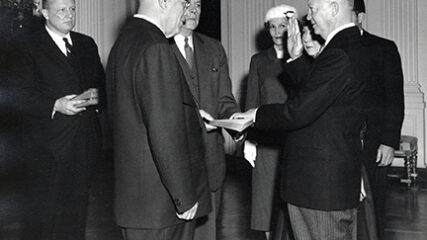
Further reinforcing the Truman Doctrine, the US President promises military or economic aid to any Middle Eastern country resisting Communist aggression.
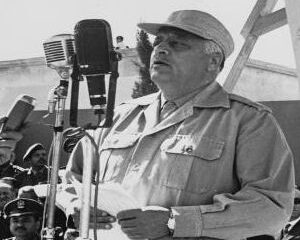
Palestine Liberation Organization seeks Israel’s destruction through armed struggle. It retains this stated policy until December 1988.

Ten days before the start of the Six-Day War, Egyptian President Gamal Abdel Nasser declares that Egypt, Syria and other Arab states intend to destroy Israel.

With tensions on its borders, Eshkol tries to reassure Israeli public. Instead he gives a “painfully faltering” speech. Popular and party disgruntlement follow, opening the way for Eshkol to turn over the Defense Ministry two days later to General Moshe Dayan.

Egyptian President Gamal Abdel Nasser asserts that the conflict with Israel is not over access to the Gulf of Aqaba but the very existence of Israel; Egypt’s foes are Britain and the United States, which support Israel.

The Israeli ambassador to the United Nations delivers a detailed outline of events that will lead to war two days later.

After the Israeli army swept through Sinai in four days, the Egyptian president acknowledges the success of Israel’s pre-emptive strike but blames the U.S. and Britain. Still, he takes responsibility for the Arab defeat and resigns.
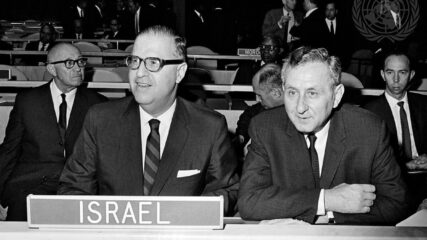
Following the conclusion of the June 1967 War, the Israeli government sent word to Egypt and Syria seeking peace plan that was intended to jumpstart a peace process with Israel’s belligerent neighbors, Egypt and Syria. The messages were sent through the US, but no response was apparently received.
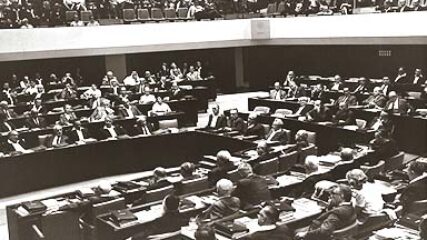
After the June 1967 war, the Israeli government sent word through the United States to Egypt and Syria seeking to jump-start a peace process. Apparently no response was received.
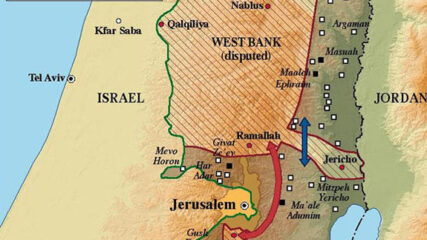
Yigal Allon’s plan for handling the areas captured from Jordan during the just-completed Six-Day War reflects Israel’s previous border vulnerability and seeks a West Bank arrangement that is not a strategic or geographic threat.

Arab states declare “no peace, no negotiation, no recognition” with Israel after their collective defeat in the June 1967 War.
Resolution 242 calls for Israeli withdrawal from unspecified captured territories in return for the right of all states to live in peace. It does not call for a full withdrawal. It is the basis for treaties with Egypt (1979) and Jordan (1994) and for PLO recognition of Israel (1993).
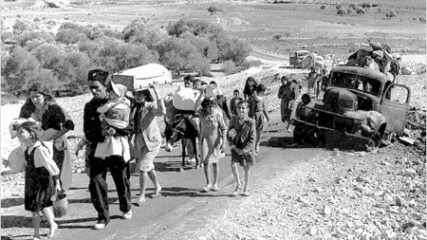
Without any consultation with Jerusalem, Israel rejects US proposal for full withdrawal.
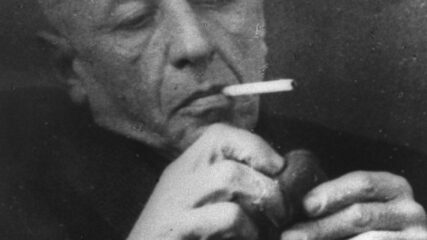
One of Israel’s greatest writers, Natan Alterman, reminded Israel’s accusers in 1969 that well into the 20th century the Palestinians did not even understand themselves as a separate people with a distinctive national identity marking them off from other Arabs. His argument, if framed as a question, might be formulated along these lines: If no one else, not least the Palestinians’ ancestors, saw their distinctive nation in Ottoman Palestine, how can the Zionists be blamed for not seeing one either? Thus, to fault the Zionists for failing to see what was not yet visible to anyone else, including the Palestinians, is to fault them not for suffering from blindness, but for lacking clairvoyance.
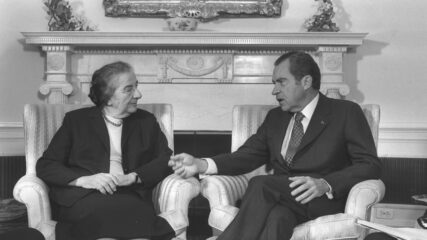
This volume of the U.S. government’s “Foreign Relations of the United States” series provides foreign policy documents on the Arab-Israeli conflict before, during and after the October 1973 war.
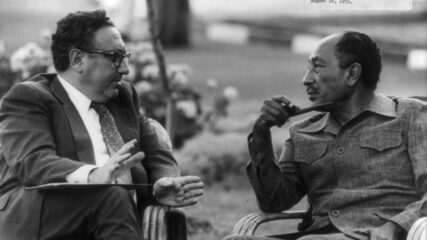
October 6, 2023, was the 50th anniversary of the outbreak of the October 1973 war. Six months prior, Egyptian President Sadat sent his national security adviser to meet with Secretary of State Kissinger to determine whether the U.S. would engage Egypt and Israel in serious mediation for a Sinai agreement, or a series of them, all focused on Israeli withdrawal and gradual acceptance of Israel. Kissinger did not take Sadat’s overtures seriously. Would American action then have avoided the October 1973 war? All informed analyses say no.

With less than three dozen Israeli settlements in the territories taken in the June War, the proposal is not for a vast settlement increase, but for economic, infrastructure, and industrial development of the areas.
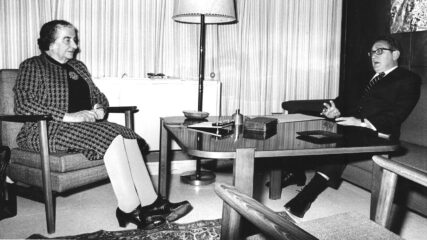
In carrying out research in the 1990s for Heroic Diplomacy: Sadat, Kissinger, Carter, Begin and the Quest for Arab-Israeli Peace, Routledge, 1999, I undertook 84 interviews with individuals who participated in the diplomacy.
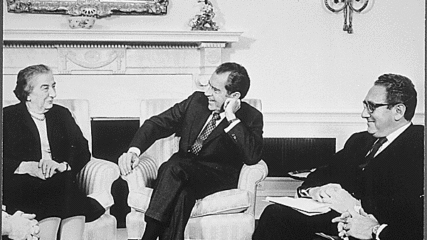
The October 1973 war broke the logjam over whether diplomacy could unfold to kick off Arab-Israeli negotiations. Sadat used the 1973 war as an engine to harness American horsepower. In that he succeeded because U.S. Secretary of State Kissinger saw Sadat’s leaning to Washington not only as a chance to begin useful negotiations, but also of great significance to weaning the Egyptian president away from Moscow.

U.S. Secretary of State Kissinger failed to persuade Syrian President Assad to attend the December 1973 Geneva Middle East Peace Conference. Assad saw the proposed conference, which it was, a ruse to cover up a “pre-cooked” Israeli-Egyptian arrangement. Assad wanted no part of implicitly supporting any agreement where Israel’s legitimacy might be enhanced.
