Presidential Proclamation Recognizing Golan Heights as Part of Israel, 2019CIE+
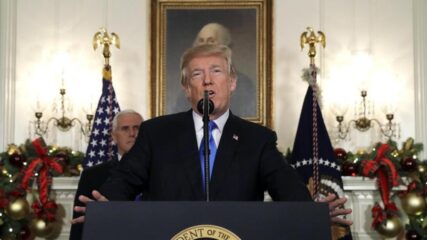
U.S. President Donald Trump recognizes Israeli sovereignty over the Golan Heights more than 37 years after Israel annexed the mountains.
The plan builds on previous proposals for a two-state solution to the Arab-Israeli conflict and contains a US-Israeli agreement that sets forth final borders for two states. The plan contains multiple prerequisites for Palestinian behavior before either the US or Israel might agree to Palestinian statehood as well as a proposed $50 economic development package to be allotted over a decade.
U.S. Ambassador to Israel David Friedman provides the most detailed Trump administration analyses of the prescribed two-state solution for terminating the Palestinian-Israeli conflict.
President Trump announces the diplomatic breakthrough under which Israel halts its plans to annex parts of the West Bank and the United Arab Emirates agrees to full diplomatic relations with Israel without any Israeli land concesssions.
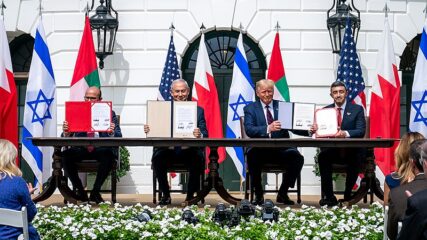
Quietly pursued in the past, long-standing strategic ties between Israel and Gulf states have become public. Building on the historic Joint Agreement signed between Israel and the UAE in August 2020, the Abraham Accords serve as a framework for normalizing diplomatic relations between Israel, the UAE and Bahrain.
January 15, 2021 The U.S. Department of Defense announced in the final week of the first Trump administration that it was shifting Israel from the area of responsibility of the U.S. European Command to the…
A week after Antony Blinken’s confirmation as Secretary of State, the Acting US Ambassador to the UN outlined with considerable detail the administration’s objective to an agreed, not imposed two-state resolution to the Palestinian-Israeli Conflict.
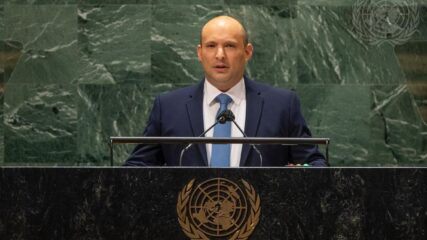
Prime Minister Naftali Bennett outlines and offers details for meeting domestic and foreign policy challenges facing Israel. He asks all the citizens of Israel to forge together under the banners of realism and practical solutions.
Affirming Israel’s strong relationship with the U.S. and normalized relations with six Arab states, Naftali Bennett castigates Iran for its support of toxic regional insurgencies and promises to prevent it from obtaining a nuclear weapon. He makes no mention of the Palestinian issue.
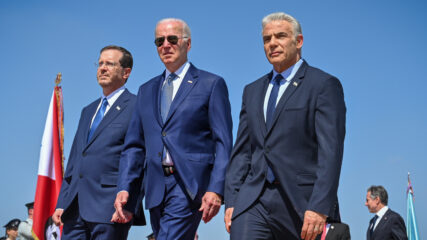
On President Joe Biden’s trip to Israel, he and Prime Minister Yair Lapid affirmed the long-term U.S.-Israel strategic relationship.
Siegel resigned over two matters: the administration’s policy of selling advanced fighter aircraft to Saudi Arabia and Egypt, which he believed a threat to Israel’s national security, and his sharp disagreement with the Carter White House for not allowing alternative views on policy matters to find their way to the President’s desk. Siegel’s detailed interview about the administration’s anti-Israeli viewpoints are explained here.
In just under an hour, Herzog emphasized the special US-Israeli relationship, citing common values between the two democracies, noting, “when the US is strong, Israel is stronger. And when Israel is strong, the US is more secure.” He cited Israel’s domestic and foreign policy challenges in its 75th year.
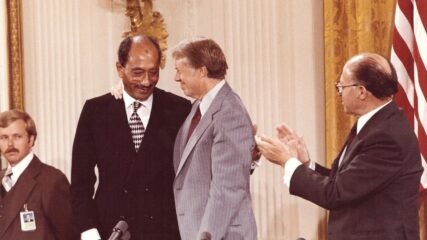
The Camp David accords culminated after thirteen days of intense negotiations between Israeli, Egyptian, and American delegations. Egyptian and Israeli leaders met with President Carter where after difficult negotiations they signed two accords, one an outline for an Egyptian-Israeli Treaty and one for Palestinian self-rule. The negotiations continued for another six months until the Egyptian-Treaty was signed in March 1979, after considerable bad feeling was tossed back and forth between Israeli and American negotiators.
The Israel State Archives has created a 16-chapter, document-based narrative of the October 1973 war, the events leading to it, and its aftermath. The landing page includes links to other documentary sources for the war….
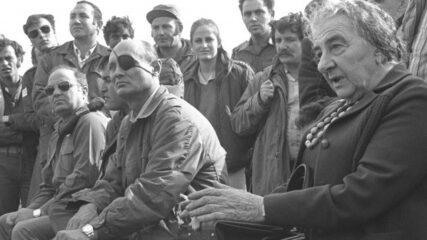
Prime Minister Golda Meir in her address to the Knesset since the beginning of the October War, recounts the war’s status on the Golan Heights and in the Suez Canal area. She reveals that an Israeli task force had crossed the Suez Canal and was fighting on the west bank of that waterway.
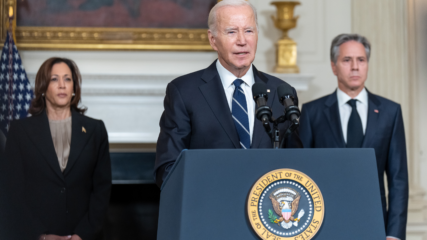
After the horrific Hamas attack on Israel, President Joe Biden unequivocally categorizes Hamas’ brutality as “pure, unadulterated evil” and reiterates that the U.S. will “stand with Israel.”
Former US President Jimmy Carter embraced Hamas as a legitimate voice of the Palestinian people. His motivations possibly stretched from intentional to misguided to malevolent. Hamas leaders who were engaged in inter-Palestinian struggles remained pleased with the recognition he gave them. American officials and Israelis were keenly perturbed by the courtship he gave them.
President Biden reaffirmed the iron-clad US commitment to Israel’s security and to eradicate the murderous nihilism of Hamas. He advocated for two states for two peoples; he committed his administration to facilitate that outcome.
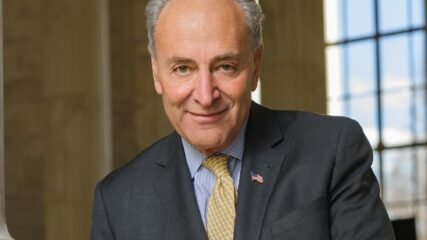
In presenting four obstacles in the way of ending the Hamas-Israel war, Sen. Chuck Schumer omits six basic obstacles that remain in the negotiating pathway to end the Palestinian-Israeli conflict.
In a 52 minute speech, Netanyahu explained Israel’s absolute need for total victory in the Gaza war because Hamas and Iran were both enemies of the United States and Israel. With bi-partisan emphasis, he thanked Presidents Biden and Trump for their unwavering current and past support. Dozens of congressional members did not attend his speech, noting disagreements with the Prime Minister’s policies.
The details of the three-stage Hamas-Israel cease-fire that went into effect January 19, 2025, along with unanswered questions, insightful analyses and the relevant U.N. resolution from June 2024.
Amid a ceasefire in Gaza, Israeli Prime Minister Benjamin Netanyahu becomes the first foreign leader to visit the White House during the second Trump administration, and President Donald Trump uses the occasion to declare his intention to take over and redevelop Gaza.
Abdullah II remains studiously noncommittal in support of Donald Trump’s idea for the U.S. to take over the Gaza Strip, rebuild it and relocate its Palestinian residents to other countries. With Jordan’s strong economic, strategic and defense ties to Washington, no one expected the king to be effusive for Trump’s suggestions for Gaza’s future. Jordan lacks the economic and demographic absorptive capacities and the political interest to take another wave of Palestinians into its territory.
Benjamin Netanyahu makes his second White House visit of Donald Trump’s second term, but the discussion this time expands beyond Gaza and regional peace to include bilateral trade after a Trump announcement of new tariffs on Israeli goods.