Proposed Constitution for State of Israel, 1948
This draft spoke eloquently about protecting individual, religious, and civil rights for all. Instead individual civil rights in Israel were protected by a series of Basic Laws.

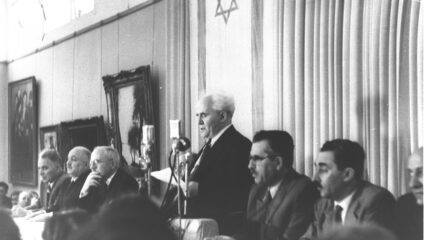
This draft spoke eloquently about protecting individual, religious, and civil rights for all. Instead individual civil rights in Israel were protected by a series of Basic Laws.
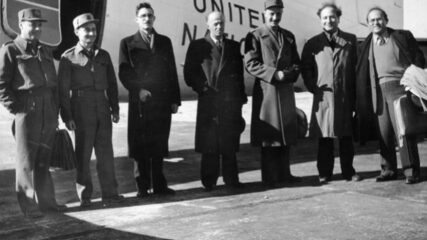
One of four agreements Israel signed in 1949 with Arab neighbors, it does not end the state of war between Israel and Egypt. They do not sign a treaty until 1979.

Jews worldwide are given the right to come to Israel and become citizens.
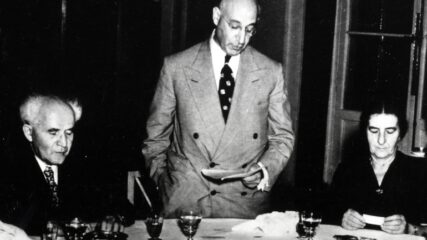
Israeli Prime Minister David Ben-Gurion and American Jewish Committee President Jacob Blaustein express a compromise in the American Jewish-Israel relationship: American Jews are excited and proud of Israel’s birth as a state but owe Israel no allegiance, and Israel does not speak for anyone but Israeli citizens.

Celebrating the creation and survival of the State of Israel, the yearbook provides a thorough history of the Zionist movement from the First Zionist Congress in 1897 to independence in 1948.
This report submitted to the United Nations at the end of 1951 notes that “some one million Jews have become the victims of accelerated antiSemitism” since 1948 in the Muslim countries of the Arab League and North Africa, “communities which have existed for thousands of years.” The report analyzes the situation for Jews overall and explains restrictions and oppressive measures country by country.

With crisp analysis, Haganah Commander Yigal Allon, later a Prime Minister of Israel attributes Israel’s successes to multiple factors including the absence of a centralized Arab command, limited Arab military training, underestimating the potential fighting capabilities of local Arabs, and Israel’s success in integrating its citizens into the war effort.

In an impassioned Knesset speech, Menachem Begin staunchly opposes accepting $1.5 billion in German reparations for Jewish deaths during WWII. No price, he believes, can be put on the lives lost.

Yitzhak Sadeh, a founder of the Haganah, provides a short history of the Haganah published in Hebrew in 1952. It is a unique verbal snapshot of the Zionist/Yishuv’s self-defense evolution taken from Sefer Toldot Hapalmach (History of the Palmach).
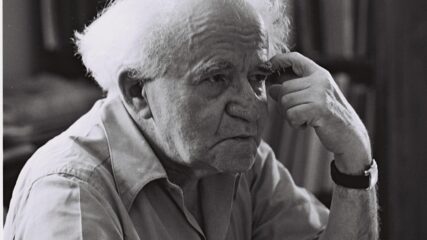
Israel’s first prime minister was a prolific writer. In this excerpt of a 50-page document, he notes that the Jewish nation’s DNA included relentless challenges marked by dispersal, ostracism and hatred by many people. Despite these adversities, Israel’s establishment symbolizes a remarkable victory against all odds — a culmination of the Jewish people’s tenacity and unyielding spirit. The state and Zionism were not remotely close to being finished, nor having succeeded in the quest for the Jewish people’s normalization.

Ben-Gurion elegantly connects modern Israel from messianic redemption to Zionism, building the country through labor and immigration, with dual needs to remain actively linked to the Jewish diaspora and Jewish values through education.

With no constitution, citizen rights and government responsibilities are stated in 14 laws. The Judiciary is covered in the Seventh Basic Law, February 1984.
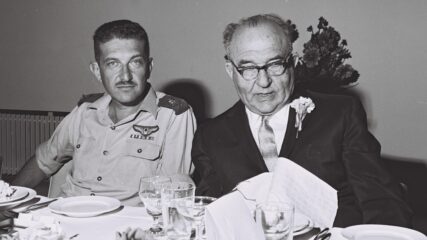
Two days after the conclusion of the June 1967 War, Eshkol, recounts the series of events that led to war, the war itself and the immediate aftermath. He reaches out to Arab states for peace seeking a path to peace with her belligerent neighbors. A week later, Israel will quietly messages Cairo and Damascus through the US, hat Israel seeks an end to the conflict. No answers are received.

Led by USSR and Arab states, Zionism is labeled as racist; the resolution is revoked in 1991.
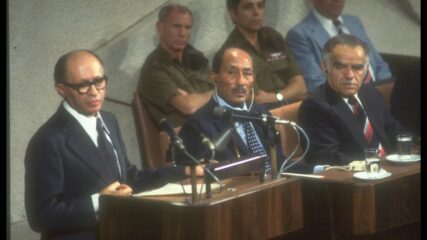
Begin welcomes Sadat’s bold initiative, seeking an end to the conflict with other Arab states through negotiated treaties. Begin invites other Arab leaders to negotiate as Sadat was doing.
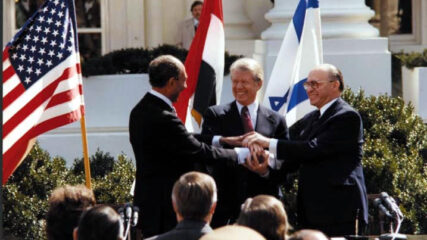
Signed sixteen months after Sadat’s visit to Jerusalem, it calls for establishment of diplomatic relations, staged Israeli withdrawal from Sinai, and American security arrangements to support the bilateral treaty.
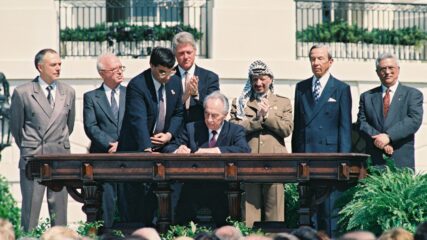
In September 2023, thirty years after the historic signing of the Oslo Accords, there is occasion to review Prime Minister Rabin’s understanding of them. I assembled this collection years ago from Daily Reports- Near East and South Asia, 1993-1995. Two short items about Rabin’s views are also found or linked here. Rabin provided a summary of his views of the Accords in a Knesset speech in October 5, 1995. Some of Rabin’s reasons for signing the Accords are also provided in Yehuda Avner’s The Prime Ministers.
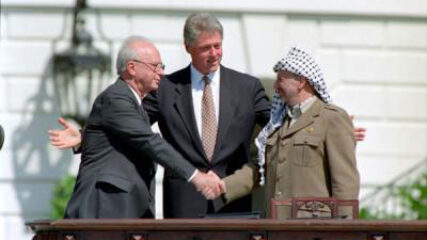
Negotiated through the Norwegians, the Oslo Accords call for limited Palestinian rule in some of the territories but do not call for a Palestinian state or an end to settlements.

Located in Jerusalem, the Central Zionist Archives has a vast array and amount of materials pertaining to modern Jewish history and particularly the history of modern Zionism. There are files dealing with all aspects of…

Novelist Amos Oz’s final speech provides a summation of a lifetime of insights into Israeli society and a vision for what Zionism has yet to accomplish.

The most recent of Israel’s Basic Laws, the statutes enacted in place of a formal constitution, controversially asserts the Jewish nature of the state, even though almost a quarter of its citizens are not Jewish.
Edited by Leonard Stein in collaboration with Gedalia Yogev, London, Oxford University Press, 1968 [Reprinted with express permission from the Weizmann Archives, Rehovot, Israel, by the Center for Israel Education.] The purpose of the work commencing with…
The biographies listed from Chaim Weizmann’s papers are those individuals with whom he corresponded from the 1870s to 1951. The list includes Americans, Europeans, Zionists and British officials. Each biography is extensive, including affiliation, career high points and other valuable information not usually available elsewhere.
The Letters and Papers of Chaim Weizmann Summer 1885 – 29 October 1902 Volume I, Series A, English Edition Edited by Leonard Stein in collaboration with Gedalia Yogev, London, Oxford University Press, 1968 [Reprinted…
